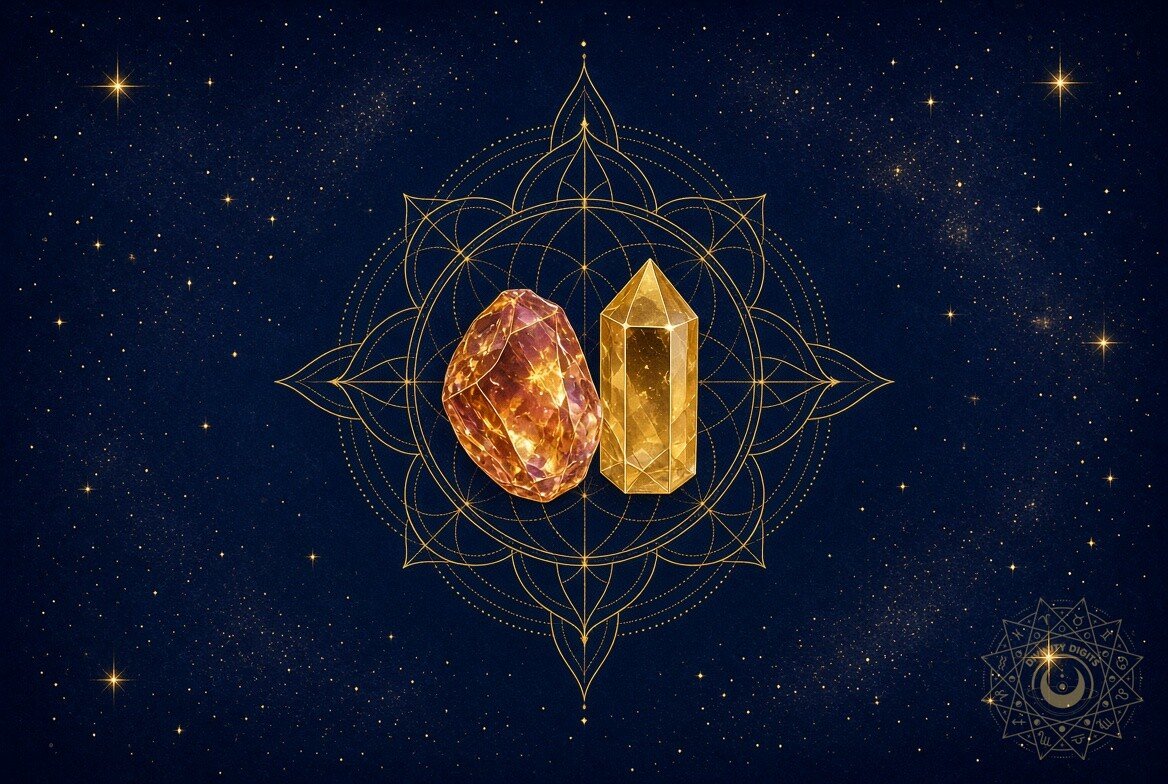
November’s birthstone is a case of mistaken identity. Topaz and citrine are unrelated minerals that look alike, and for centuries buyers and jewelers treated them as one stone. The calendar now lists both. One of them is rarely what it appears to be: most citrine on the market began as purple amethyst.
As with every topic here, none of this is scientifically validated. No controlled study has found that a gemstone changes a person’s health, luck, or personality. What follows is documented history and tradition, and it flags which parts are folklore.
Why Does November Have Two Birthstones?
GIA’s birthstone guide lists topaz and citrine as the two birthstones for November. The American Gem Society adds the catch: they are unrelated minerals, yet they look similar enough that they have been mistaken for each other throughout history. For long stretches, every yellow gem was called topaz and every topaz was assumed to be yellow.
Citrine is the yellow variety of quartz. Before gemology sorted it out, sellers used names such as gold topaz, Madeira topaz, and Spanish topaz for it, according to the American Gem Society’s citrine history. Many jewelers treat topaz as the traditional November stone and citrine as the later addition. The sources checked for this article disagree on when citrine was added, so no year is given here.
Topaz: The Stone Said to Break Spells
GIA notes two competing origins for the name. Some trace it to the Sanskrit tapas, meaning fire. Others trace it to the Greek topazos. The lore is just as varied. The ancient Greeks believed topaz gave them strength. From the 1300s to the 1600s, Europeans thought it could break magic spells and dispel anger. GIA also reports that many people in India have long believed topaz worn above the heart assures long life, beauty, and intelligence.
The American Gem Society lists older claims still. The tradition says topaz prevented sleepwalking, reduced inflammation, improved eyesight, and changed color near poisoned food or drink. Its healing power and color were also said to rise and fall with the phases of the moon. Modern medicine has not supported any of these claims.
Imperial Topaz and a Royal Monopoly
Imperial topaz is the pinkish orange variety, and its name has two competing stories. GIA says it is commonly believed to come from the Russian royal family’s insistence on keeping the finest colors from the Ural Mountains for their own use. The American Gem Society says only royals could own it. An alternate explanation, popular in Brazil, traces the name to an 1881 visit by Emperor Pedro II to Ouro Preto and the gift of a reddish topaz to him. GIA presents both as explanations rather than proven fact.
Brazil’s Minas Gerais state has been mined for topaz for more than two centuries, per GIA. The American Gem Society says large Brazilian deposits found in the mid-19th century made topaz far more affordable. Northwestern Pakistan produces pink topaz. GIA says Ghundao Hill near Katlang has been mined since 1972, and the most sought-after shade there carries a tinge of violet that the trade calls cyclamen pink. Even there, fine pink topaz is found only rarely.
Most Blue Topaz Is Not Natural Blue
GIA lists topaz in colorless, light blue, yellow, orange, pink, violet, and brown, and very rarely red. It reports that the vast majority of blue topaz sold today is the permanent result of irradiating and heating colorless stones. The rainbow sheen on Mystic Topaz comes from a thin artificial coating on colorless topaz. The American Gem Society adds that these treatments so closely resemble how topaz forms in nature that there is practically no way to tell whether a given stone was treated.
Watch for: Mystic Topaz coatings. GIA warns that abrasive cleaners and buffing wheels remove them, so use only a mild soap solution.
Citrine: Mostly Heat-Treated Amethyst
Citrine is the transparent yellow to brownish orange variety of quartz. GIA says its name is believed to come from the French citron, meaning lemon. The American Gem Society says the word was used for yellow gems as early as 1385, when it was first recorded in English, and that traces of iron in quartz cause the color. That happens rarely in nature.
The market runs on a mid-18th-century discovery. Mineralogists found that amethyst and smoky quartz could be heat treated into lemony, golden stones. GIA says most citrine sold today results from heat-treating amethyst, which is mined mostly in Brazil. Natural, unheated citrine does exist. Bolivia’s Anahí mine is an important source, and it also produces ametrine, where purple and yellow share one crystal. GIA recounts the mine’s story this way: a Spanish conquistador in the 1600s received it as a dowry when he married Anahí, a princess of the Ayoreos tribe, and the mine was lost for three centuries before it was rediscovered in the 1960s.
Citrine’s lore overlaps with topaz’s. The American Gem Society says people once believed citrine could calm tempers, soothe anger, and manifest desires, especially prosperity. Egyptians used it as talismans, the ancient Greeks carved images into it, and Roman priests set it in rings. One tradition held that it was among the few gemstones that never held negative energy. That is lore, not a tested property.
Caring for Topaz and Citrine
Hardness and toughness are different things, and topaz shows it. GIA rates topaz 8 on the Mohs scale, but says its poor toughness means it can chip or crack if knocked. GIA advises against steam and ultrasonic cleaners and warns that high heat or sudden temperature changes can cause internal breaks. Its color is generally stable in light, though long exposure to heat or sunlight may fade some yellow to brown stones. Warm, soapy water works best.
Citrine rates 7 and has good toughness, per GIA, so it handles normal wear. Warm, soapy water is safe, and an ultrasonic cleaner is usually acceptable. Steam is risky because high heat could crack the stone. A reasonable reading of those ratings: citrine suits a ring worn daily, while topaz is better kept for earrings and pendants that take fewer knocks.
November birthdays also straddle two zodiac signs, Scorpio and then Sagittarius from around November 22. Zodiac stone lists differ from source to source and are a separate tradition from birthstones. For the sign side, see Scorpio Season 2026: Dates, Retrogrades, and What to Expect and How to Choose the Right Crystal Based on Your Zodiac Sign.
Frequently Asked Questions
What is the real November birthstone, topaz or citrine?
Both. GIA lists topaz and citrine as November’s two birthstones.
Are topaz and citrine the same stone?
No. Topaz is its own mineral and citrine is a variety of quartz. The American Gem Society calls them unrelated. They look similar, which is why they were mistaken for each other for centuries.
Is most citrine natural?
No. GIA says natural citrine is rare and most of what is sold comes from heat-treated amethyst.
Is blue topaz natural?
Rarely. GIA reports that the vast majority of blue topaz seen today is colorless topaz treated by irradiation and heating, and that the result is permanent.
Did topaz really detect poison?
There is no evidence it did. The American Gem Society lists it as an old belief, alongside claims that topaz cured sleepwalking and improved eyesight. No controlled study supports any of them.
Which wedding anniversaries use these stones?
GIA lists blue topaz for the fourth anniversary, Imperial topaz for the 23rd, and citrine for the 13th.
Which is better for everyday wear?
Based on GIA’s ratings, citrine is the safer pick for a ring. It has good toughness, while topaz has poor toughness. Topaz is harder, so it resists scratches better, but it chips more easily if knocked.
So Which November Birthstone Should You Choose?
Choose citrine for a durable, affordable, sunny stone that is probably heat-treated amethyst. Choose topaz for a wider range of colors and a longer trail of folklore, if you accept gentler handling. The American Gem Society notes that both stones are fairly abundant and affordably priced, so budget rarely decides it.
For another month that carries two stones, see October Birthstone: Why Opal and Tourmaline Both Claim the Month. For a case where three traditions each name a different stone, read Virgo Birthstone: Sapphire, Peridot, or Emerald? The Real Answer.
Discover more from Divinity Digits
Subscribe to get the latest posts sent to your email.