In July 1976, a NASA orbiter photographed a Martian hill that looked like a human face. The science team dismissed it as a trick of light and shadow. A 2001 photograph with far finer detail showed an ordinary mesa. That is pareidolia: the brain seeing a face in a vague image. Research says it comes from face-detection circuits that prefer false alarms to misses, and it is normal. It explains faces in clouds and voices in static. It does not show that clouds carry messages. This guide checks the studies, then tests the common claims about angel signs.
Pareidolia: Key Facts
- Meaning: seeing faces or patterns in ambiguous images
- The word: Greek para (beside) and eidolon (image)
- Status: a normal feature of perception, not a diagnosis
- Best-known case: the Face on Mars, photographed by Viking 1 on 25 July 1976
- What research supports: illusory faces drive the same brain systems as real faces
- What no research supports: that a shape in a cloud is a message
What Pareidolia Is
Pareidolia is the tendency to find a meaningful figure in something random, most often a face. A 2020 study in Psychological Science, as Live Science reports it, suggests people evolved quick face detection, and face pareidolia is the false positive of that system. The cost of missing a real face is higher than the cost of a false alarm, so the system leans toward alarms. Psychology Today stresses that pareidolia is not a clinical diagnosis or a disorder.
The Mechanics: What the Studies Show
A 2021 study led by David Alais at the University of Sydney, published in Proceedings of the Royal Society B, found that objects that look like faces are processed like real faces. The brain does not discard them as errors. It also reads their expressions, which is why a lake can look as if it is scowling. We read this through a PsyBlog summary and did not open the paper.
Watch for: the jump from “I saw a face” to “it was sent for me.” The research explains the first step. It says nothing about the second.
Macroscopic Symptoms: The Face on Mars
- 25 July 1976: Viking 1 photographs a hill in the Cydonia region that looks like a face. The science team calls it a trick of light and shadow. Part of one “eye” and a “nostril” in the image are bit errors from transmission, according to Astronomy Notes.
- 35 orbits later: a second Viking image, taken at a different sun angle, still shows a face-like shape.
- April 1998: Mars Global Surveyor photographs the hill at about ten times the detail of the best Viking image.
- 8 April 2001: Mars Global Surveyor images the hill again at about 1.56 m per pixel. Universe Today says the later images show natural features with no sign of construction.
- 2020 to 2022: studies of face detection and of voice pareidolia follow.
The pattern is instructive. A blurry picture produced a face, and a sharper picture removed it. Angel-sign claims usually work the other way: the sharper you look, the more detail you invent.
Where Sources Disagree
- The size of the Face on Mars: Universe Today says about 2 km long, and Michael Bach‘s page says about 2.5 km by 2 km. We state no single size.
- Pareidolia and the paranormal: Live Science summarises a 2022 PLOS ONE study as finding that people prone to pareidolia may report more paranormal experiences. The paper’s abstract describes a test of hearing voices in recordings with 61 participants, split into a primed group and an unprimed group. The primed group found more voices in purported ghost recordings than in degraded speech, and did not find more voices than the unprimed group did. Sciencing says the belief link rests on one small study. We treat the link as unsettled.
- The feather tradition: many sites say white feathers are signs from angels or loved ones. A Catholic writer at Women of Grace says the idea is promoted by mediums and New Age writers and differs from the biblical picture of angels. We report both views and take no side.
The Sign Ledger
This table is our own selection of common signs, with the best-fit explanation for each.
| Sign | What you perceive | Best-fit explanation | What testing shows |
|---|---|---|---|
| Face in a cloud | A face | Face pareidolia | Illusory faces drive the face-detection system. Nothing shows a cloud carries a message. |
| Face on Mars | A face on a hill | Pareidolia plus a low-detail photo | Sharper images showed a natural hill |
| Voice in static | A spoken word | Auditory pareidolia | A 2022 study found a partial and mixed priming effect |
| Repeating number | 11:11 on a clock | Frequency illusion, not pareidolia | See our 1212 guide |
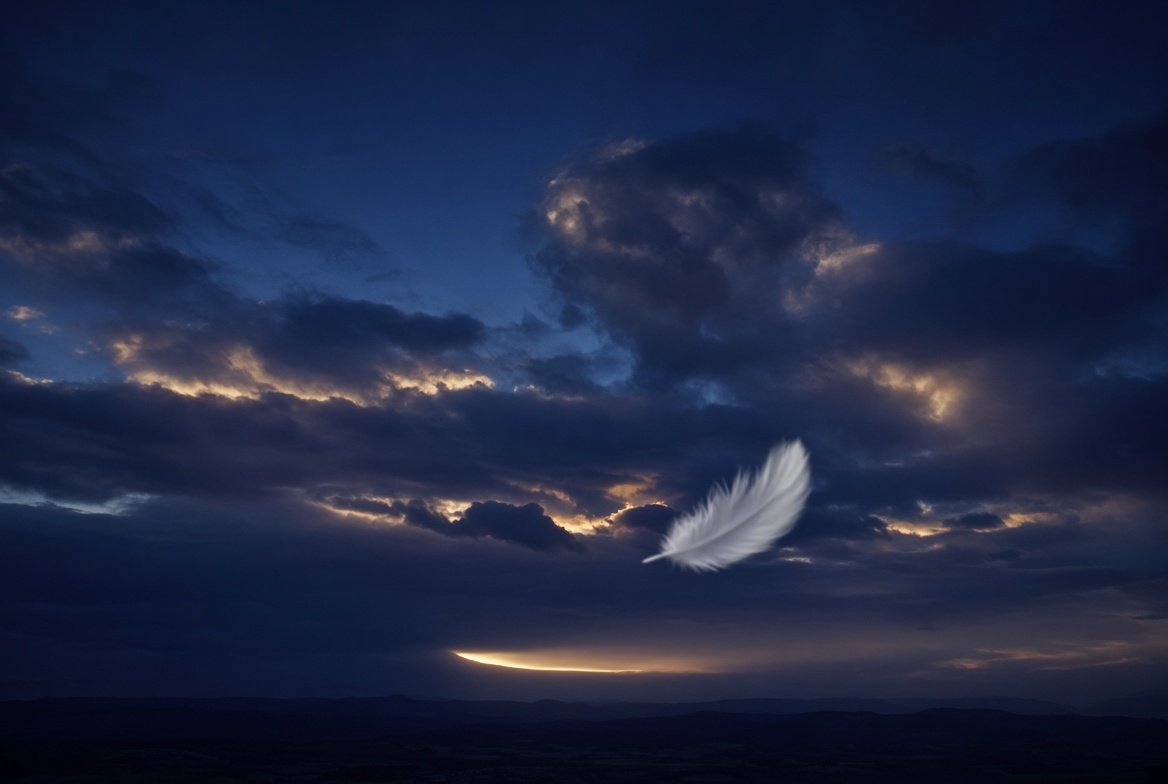
| White feather | A real feather | A real object noticed through selective attention | We found no test of a feather as a message |
Recorded Symptoms
These are illustrative composites, not real case files.
Symptom 1. A reader sees an angel-shaped cloud on the morning of a funeral and takes it as a message. She found the shape after she started looking. She cannot know whether she would have found a dog or a boat on another day.
Symptom 2. A man plays a recording of static to a friend and says it contains ghost voices. The friend hears a sentence. A second friend, told only that it is noise, hears nothing. The suggestion supplied the sentence.
Insulation Protocols: A Two-Scan Test
This is our own informal method, not a study. It shows how much looking for a shape changes what you find.
- Pick a surface. Use a cloudy sky, a wall or a tree trunk.
- Scan for two minutes and only describe. Note shapes without hunting for faces.
- Scan for two minutes and hunt for faces. Count how many you find.
- Ask a friend to prime you. They say that people often see angels in clouds. Scan again and count.
- Compare the three counts. A rising count shows how much expectation shapes perception.
If a sign comforts you during grief, nothing here tells you to stop. This article tests only the claim that the sign carries a message. For the number side of this topic, see our guide to angel number 1212, and for why a vague description can feel personal, see the Barnum effect and the Forer experiment.
Plain note: no study shows that clouds, feathers, numbers or sounds predict events or carry messages.
FAQ
What is pareidolia?
Pareidolia is seeing faces or other patterns in ambiguous images, such as a face in a cloud or the man in the moon. The word comes from the Greek para, meaning beside, and eidolon, meaning image.
Is seeing an angel in a cloud pareidolia?
Yes, if the shape is vague and you find a figure in it. The face-detection system of the brain treats a face-like shape as a face. That explains the seeing. It does not show the cloud carries a message.
Is pareidolia a sign of mental illness?
No. Psychology Today says it is not a clinical diagnosis or a disorder. If visions distress you or come with other symptoms, talk to a clinician.
Is a repeating number like 11:11 pareidolia?
Not strictly. A clock face is not an ambiguous image. The better-fitting term is the frequency illusion, which our guide to angel number 1212 covers.
Do white feathers come from angels?
The tradition says so, and sources differ on where the belief comes from. We found no test of it. A feather is a real object, so pareidolia is the wrong tool for it.
Do believers see more pareidolia than sceptics?
Unsettled. A 2022 study of ghost-voice recordings gave a partial and mixed result, and one summary says the belief link rests on a small study.
Aftermath
Pareidolia explains why a shape can look like a face, a figure or an angel. The tradition says some of these shapes are signs. The studies say the brain produces the shapes, and no test shows that anything sends them. Both statements can sit with a person who finds a sign meaningful, as long as the meaning is described as theirs.
External Data Check
Popular pages on angel signs and white feathers present the meaning as settled. They cite folklore, mediums and personal stories, not tests. One feather page we read, from a pharmacy library, says that once you are told a feather is a sign, your brain starts scanning for it. That is the frequency illusion in plain words, and it undercuts the page’s own tradition. We sampled a handful of pages and did not survey the field.
Sources
- Live Science, What is pareidolia?: the definition, the 2020 and 2022 studies as summarised.
- PsyBlog, Pareidolia: Why Our Brains See Faces Everywhere: the Alais 2021 study as summarised.
- Psychology Today, Pareidolia: not a clinical diagnosis or disorder.
- Sciencing, Why people see faces on everyday objects: the Greek roots and the caution on the belief link.
- Williams and Blagrove (2022), PLoS One 17(9): e0274595: the abstract of the voice pareidolia study.
- Swansea University record of the same paper: the participant numbers.
- Michael Bach, Face on Mars: the 1976 image, the 1998 reshoot and the size estimate.
- Universe Today, What is Cydonia?: the dismissal as light and shadow and the second Viking image.
- Astronomy Notes, The Face on Mars: the bit errors and the 1998 image.
- Farmers’ Almanac, Signs a Deceased Loved One Is Near, and Women of Grace, Is a White Feather a Sign from Beyond the Grave?: the feather tradition and one objection to it.
We could not verify: the 2020 Psychological Science paper, the 2021 Alais paper and the 2022 PNAS finding at their sources, NASA’s original statements, or the origin of the white-feather belief. The Sign Ledger and the two-scan test are our own.
Last reviewed: 14 November 2026.