January’s birthstone takes its name from a fruit, adorned Egyptian pharaohs, and is not one gem but a family of more than twenty. Garnet is the rare birthstone that rewards a closer look, because the single word hides a range from wine red to the green of a fresh emerald, and the green ones can cost more per carat than the red ones by a wide margin. This guide separates the species, the history, the folklore and the practical facts a buyer needs.
As with every topic here, none of this is scientifically validated. No controlled study has found that a gemstone changes a person’s health, luck, or personality. What follows separates documented history from tradition and flags the folklore.
One Birthstone, Twenty Minerals
GIA’s birthstone guide lists garnet as January’s birthstone. The word, however, names a group of related silicate minerals that share a crystal structure but differ in chemistry. According to GIA, the family includes more than 20 recognized species. Five carry most of the jewelry trade: pyrope, almandine, spessartine, grossular and andradite.
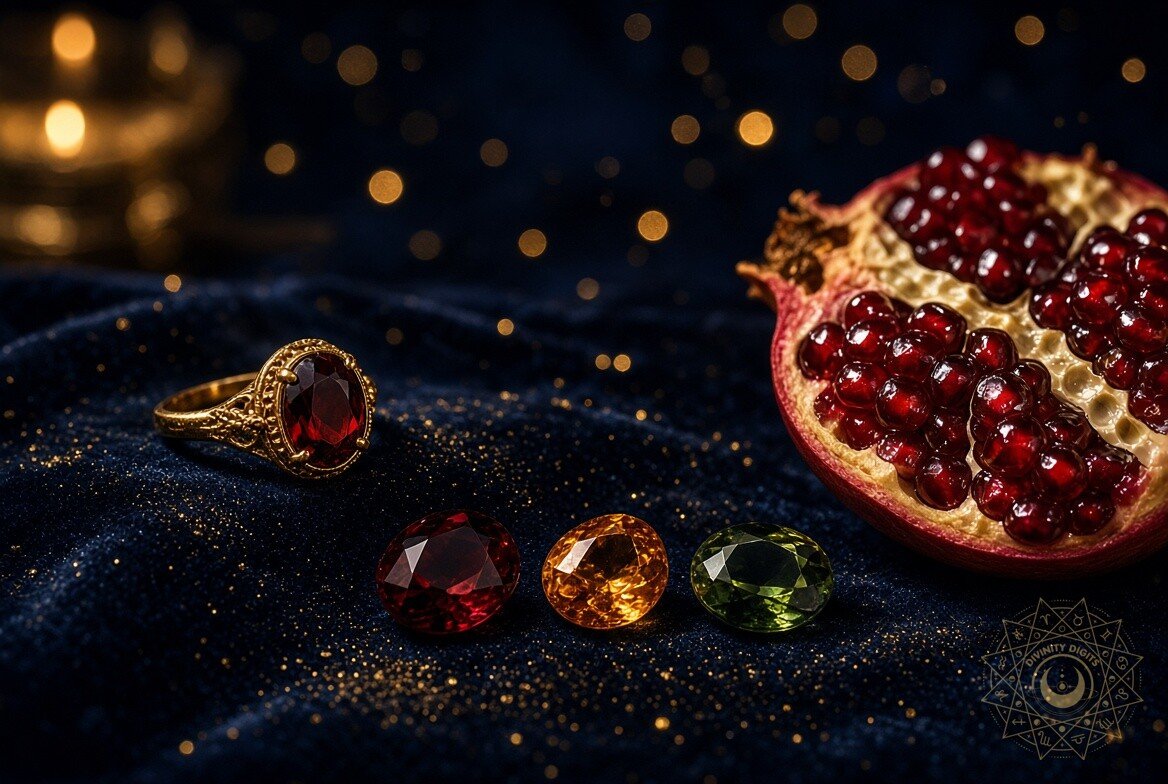
Chemistry explains the colours. Iron and aluminium give almandine its deep red to purplish red. Magnesium shifts the balance toward the brighter red of pyrope. Manganese yields the orange of spessartine. Calcium-bearing garnets, grossular and andradite, give the yellows, oranges and greens. A jeweller who says “garnet” without a species is describing a family and not a stone, much as a florist who says “rose” has not yet named a variety.
A Name Taken From a Fruit
The name comes from the medieval Latin granatus, meaning pomegranate, in reference to the resemblance between small red garnet crystals and the fruit’s seeds. GIA reports that people have used garnets since the Bronze Age, as gemstones and as abrasives. The second use survives: industrial garnet still polishes and cuts, because the mineral is hard and fractures into sharp edges.
An older word shows how wide the early vocabulary was. In ancient and medieval texts, carbuncle covered any red gemstone, garnet included. A writer who mentions a carbuncle in a treasure list may mean a garnet, a ruby, a spinel or something else, and modern scholars often cannot tell which. The same looseness affects tradition about many stones, and it is one reason we treat claims about ancient “ruby” and “garnet” with caution.
The physical record is firmer. Gemstone suppliers’ reference sheets note that red garnet necklaces adorned Egypt’s pharaohs thousands of years ago, and the Bronze Age use GIA reports sits well with that. Later, garnets lit up Roman intaglios and Bohemian brooches, and Victorian mourning jewelry made extensive use of almandine and pyrope. Garnet has stayed fashionable for so long because it is plentiful, durable and handsome, and fashion has not needed a mystery to sustain it.
How the Birthstone Calendar Came to Name Garnet
The idea of one gem per month borrows from much older lists. The most famous is the set of twelve stones set in the High Priest’s breastplate in the Book of Exodus, which later writers connected first to the tribes of Israel and then to the months and the zodiac. Those early lists did not agree on the stones, partly because the ancient names covered more than one mineral. The carbuncle problem described above lies behind much of the confusion.
The modern American list took shape in 1912, when the national association of jewellers standardised the stones for each month. Garnet kept January through that standardisation, and the later revisions, which added stones such as zircon and tanzanite for December, left January alone. Our birthstone chart guide sets the months side by side. A birthstone list is a trade convention with a historical pedigree, and different countries keep different lists.
The Five Species the Trade Sells
| Species | Typical colour | What to know |
|---|---|---|
| Almandine | Deep red to purplish red | The most common garnet. Named, according to etymologists, for Alabanda, an ancient city in modern Turkey that served as a centre of gem cutting. |
| Pyrope | Bright to deep red | Classic “garnet red”. Common in antique jewelry. The Smithsonian’s National Gem Collection holds an antique pyrope garnet hair comb. |
| Spessartine | Orange to reddish orange | Vivid and saturated. Often shows visible inclusions in the paler oranges. |
| Grossular | Colourless, yellow, orange-brown, green | Widest colour range of any garnet. Takes its name from the Latin for gooseberry. Includes hessonite (brownish orange) and tsavorite (green). |
| Andradite | Yellow to green | Includes demantoid, the prized green variety. |
Watch for: a shop that sells “garnet” cheaply and one that sells it at emerald prices may both be honest. The first probably has almandine. The second probably has tsavorite or demantoid.
The Rare Greens: Tsavorite and Demantoid
Two garnets sit at the top of the family’s price range, and both are green. Tsavorite is the green variety of grossular. According to jewellers’ references, prospectors found it in East Africa in the 1960s, and most of it still comes from Tanzania, Kenya and Madagascar. Demantoid is the green variety of andradite. The Ural Mountains of Russia have long supplied the finest material.
Demantoid carries two curiosities. First, it has dispersion, the optical property that splits white light into spectral colour, higher than diamond’s, which gives a well-cut stone a distinctive fire. Second, collectors prize a flaw. Fine Russian demantoid often contains fine, radiating fibres called horsetail inclusions, and where most gems lose value from inclusions, this one gains. Demantoid is also slightly softer than the other major garnets, so it asks for a protective setting.
Colour Change and Other Oddities
The rarest garnets change colour with the light, shifting from blue to purple or from greenish to red depending on whether sunlight or incandescent light falls on them. The effect resembles the one that made alexandrite famous. These stones are collectors’ items, not trade staples, and a buyer who finds one at a low price should ask for a laboratory report.
What the Tradition Says
The tradition attaches fidelity, friendship and protection to garnet, and it ties the stone to safe return from travel. Those meanings come from folklore and jewellers’ lore, not from any experiment. One plausible explanation for their long life, though not a documented one, is that a deep red stone resembles blood, fire and fruit, and people tend to attribute vitality to things that look vital. The tradition also names garnet as the traditional gift for a second wedding anniversary.
We record these associations as a cultural fact, in the same way that a historian records the symbolism of a flag. They tell you what people believed. They do not tell you what the stone does.
Where Garnets Come From
Because the family is large, the sources are many. Jewellers’ reference sheets list major sources in Afghanistan, Brazil, India, Iran, Kenya, Madagascar, Myanmar, Namibia, Pakistan, Russia, Sri Lanka and Tanzania. A reader in South Asia lives close to several of them. Pakistan appears on that list, and Sri Lanka and India have supplied gem garnets for centuries. The geography matters for a practical reason: a stone’s origin often tells you its species. East African deposits are the usual source of tsavorite, and Russia has the reputation for demantoid.
Hessonite and the Astrological Gem Tradition
The astrological traditions of South Asia treat one garnet as a gem in its own right. In the Vedic jyotish tradition, hessonite, the brownish orange variety of grossular, is known as gomed and the tradition assigns it to the planet Rahu. Astrologers in that tradition prescribe it as a remedial gem, and it sells in large numbers to readers who follow the system.
We report this as a cultural practice, with a label: the tradition says hessonite pairs with Rahu, and no study shows that wearing it changes anything. The gemological facts are separate. Hessonite often carries eye-visible inclusions, which is why jewellers use it less than the clearer red garnets, and the stones sold as gomed vary widely in quality and price. A buyer who follows the tradition should still ask for the species and treatment, and should be wary of any seller who sells a protective stone as a guarantee.
A Buyer’s Short Method
- Name the species. Ask whether the stone is almandine, pyrope, spessartine, grossular or andradite. The answer sets the price range.
- Judge colour first. A bright, even colour matters more in garnet than in most stones. The red garnets, almandine, pyrope and rhodolite, typically show no eye-visible inclusions. Orange garnets such as spessartine and hessonite often do.
- Ask about treatment. Most garnets are untreated. Ask to confirm, and for green stones ask specifically about heat.
- Match the setting to the species. Harder reds suit rings. Demantoid belongs in a bezel, an earring or a pendant.
- Request a report for any stone you pay a premium for, such as a tsavorite, a demantoid or a colour-change garnet.
Treatment and Authenticity
Garnet has a modest advantage over most coloured gemstones: sellers rarely treat it. Where blue topaz, amethyst and tanzanite usually arrive heated, most garnets reach the market as they came from the ground. Two exceptions exist. GIA notes that sellers might rarely treat garnets by fracture filling. Some sellers also report that demantoid sometimes receives low heat to improve colour. In both cases, ask the seller to disclose.
Substitutes also exist. Red glass and synthetic stones can imitate garnet, and a buyer who wants certainty about a valuable stone should request a laboratory report, particularly for green or colour-change material.
Durability and Care
| Property | What GIA reports |
|---|---|
| Hardness | 6.5 to 7.5 on the Mohs scale. Almandine, pyrope, spessartine and tsavorite sit on the harder side. Demantoid is a little softer. |
| Toughness | Fair to good. Durable enough for all jewelry styles with proper care, but avoid hard blows. |
| Stability | Stable to light and chemicals. Hydrofluoric acid can attack it. |
| Cleaning | Warm soapy water is always safe. An ultrasonic cleaner is usually safe, except for fractured stones. GIA does not recommend steam cleaning. |
A red garnet in a ring will last for decades if you remove it before heavy work. A demantoid in a ring will need a bezel or a protective setting. Garnet is also lighter on the budget than ruby or sapphire, which makes it a sensible choice for a first coloured-stone ring.
Frequently Asked Questions
What is the January birthstone?
Garnet, according to GIA. It is a group of more than 20 species, though five account for most jewelry.
Is garnet always red?
No. Garnet occurs in nearly every colour, and the green tsavorite and demantoid are among the most valuable members of the family. Red remains the colour most people associate with the name.
Is garnet treated?
Rarely. Most garnets reach the market untreated. Fracture filling is rare, and some demantoid receives low heat. Ask the seller for disclosure.
Is garnet durable enough for an engagement ring?
Many garnets can serve in a ring with care. GIA gives a hardness of 6.5 to 7.5 and fair to good toughness. Harder species suit daily wear better. A diamond, ruby or sapphire resists scratches more.
What is rhodolite?
Rhodolite is a raspberry-pink to purplish-red garnet, a blend of pyrope and almandine chemistry. It sells widely as a softer-toned alternative to classic red and often costs less than the rarer greens.
How is garnet different from the other winter birthstones?
Garnet is a family, mostly untreated and relatively affordable. Our guides to the November birthstone and the December birthstone show how much treatment shapes those stones, and the birthstone chart guide places all twelve side by side.
So Which Garnet Should You Choose?
Choose almandine or pyrope for the classic red at an honest price, spessartine for a vivid orange, and tsavorite or demantoid if the budget allows and the green appeals. Ask for the species by name. The list of birthstones is a trade convention, built by jewellers over a century, and the stories attached to each stone come from tradition and marketing. No study shows that a birthstone predicts or changes anything. If a seller promises results, walk away. If you like the stone, wear it.
Sources
- GIA, January birthstones: the Latin origin of the name, Bronze Age use and the Smithsonian pyrope comb.
- GIA, garnet care and cleaning: hardness, toughness, stability and cleaning advice.
- Diamond Rocks garnet reference sheet: sources, varieties, treatments and the Egyptian necklaces (a trade sheet, used for tradition and trade practice).
- Farmers’ Almanac, January birthstone, citing GIA: the number of species and the carbuncle usage.
- Stonemania, garnet: the etymologies of almandine and grossular (a hobby site, used for etymology only).
We could not verify at a primary source: the hessonite and Rahu pairing in the Vedic jyotish tradition, which we know from general knowledge of that tradition and mark as tradition; the 1912 list details; and the link between the Exodus breastplate lists and the months.
Last reviewed: 4 November 2026.
Discover more from Divinity Digits
Subscribe to get the latest posts sent to your email.