In the early 1700s the papal authorities in Bologna objected to how a tarot deck described their government, and the printers replaced the Pope card with a Moorish king. Other decks swapped him for Jupiter or Bacchus. The card has been moved, renamed and defended ever since. In A. E. Waite’s list, the upright Hierophant means marriage, alliance, captivity and servitude, with mercy and goodness and inspiration added. Reversed, he means society, good understanding, concord, overkindness and weakness. Modern pages say tradition and conformity instead. This guide checks the card against Waite’s text, the early decks and three Hebrew-letter systems.
One detail first. Only two of five common modern keywords appear in Waite’s list: marriage and mercy. Tradition, conformity and teaching are later additions.
The Hierophant Tarot Card: Key Facts
- Number: V, the fifth trump of the major arcana
- Waite’s upright keywords: marriage, alliance, captivity, servitude; by another account, mercy and goodness; inspiration; the man to whom the querent has recourse
- Waite’s reversed keywords: society, good understanding, concord, overkindness, weakness
- Rider-Waite-Smith image (1909): a figure in a triple crown between two pillars, a sceptre with a triple cross, crossed keys at his feet and two kneeling ministers
- Astrological tradition: Taurus, with the Hebrew letter Vav, in the Golden Dawn system
What Does the Hierophant Mean in Tarot?
Waite describes the figure as the ruling power of external religion. He calls him the channel of grace for the institutional world and says the card is not philosophy, not inspiration and not religion itself, though it is one mode of its expression. He also says the meanings of the card have suffered what he calls a woeful admixture from nearly all hands. That is a warning from the author of the best-known deck: later commentators added to this card more than to most.
The pairing matters. Waite sets the Hierophant against the High Priestess, who he says makes no sign. The Hierophant gestures. One card is the visible, taught side of a tradition, and the other is the withdrawn, esoteric side. Our guide to the High Priestess covers her half of the pair.
What the Card Shows
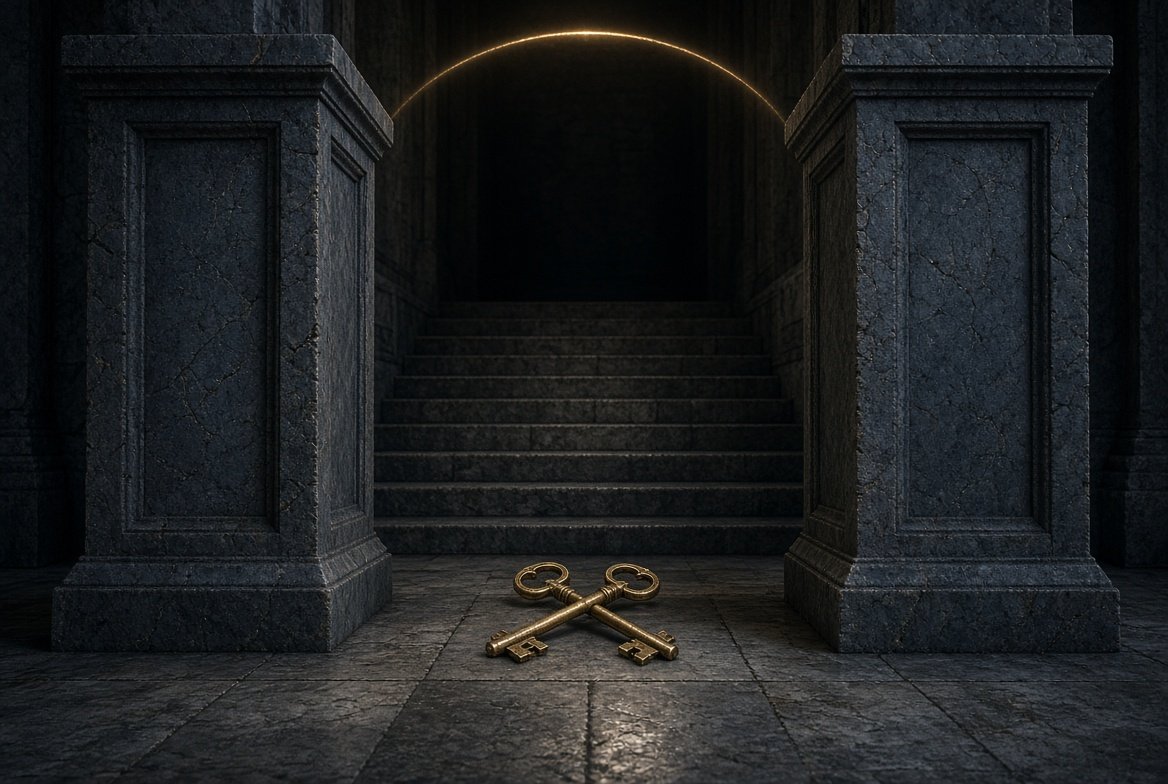
In the Rider-Waite-Smith image he wears a triple crown and sits between two pillars. Waite says these are not the Temple pillars guarded by the High Priestess. His left hand holds a sceptre topped with a triple cross. His right hand makes a sign that Waite calls esotericism, distinguishing the manifest part of a doctrine from the concealed part. Crossed keys lie at his feet, and two ministers in albs kneel before him.
Macroscopic Symptoms: A Timeline of the Pope Card
- Late 15th century: the Budapest Tarot, the earliest block-printed deck cited by Tarot Heritage, shows a Pope with a double crown and the keys of Saint Peter on a shield. That page suggests the figure may depict Felix V, an anti-Pope who stepped down in 1443, and says the same may be true of the Visconti-Sforza Pope. It presents both as uncertain.
- About 1650 to 1751: the Marseille pattern shows a bearded Pope in a triple crown giving a blessing, with two tonsured figures looking up. The Noblet deck (about 1650) adds a shepherd’s crook.
- 1725 to 1762: a Bolognese deck substitutes a Moorish king, Besançon decks late in the century use Jupiter, and a 1762 deck by Vandenborre uses Bacchus.
- 1781: Antoine Court de Gébelin calls the figure High Priest and pairs him with the Popess as an Egyptian-style couple.
- 1856: Éliphas Lévi calls the card the Grand Hierophant, seated between pillars.
- 1909: Waite and Pamela Colman Smith follow Lévi’s design closely, according to Tarot Heritage.
Where Sources Disagree
The Visconti-Sforza Pope, painted by Bonifacio Bembo according to the sources we read, shows an enthroned pontiff on a gold ground. Some writers name Nicholas V, and Tarot Heritage names Felix V. Neither identification is established. We list both and rely on neither.
The Hebrew letters disagree too, and the Golden Dawn system differs from the French one.
| System | Hebrew letter | Sign or sense |
|---|---|---|
| Lévi and French tradition | Heh | Breath of life, fifth letter for fifth trump |
| Golden Dawn | Vav (nail) | Taurus, Path 16 |
| Crowley, Thoth deck | Vav | Taurus, ruled by Venus |
The Five-Point Binary Grid: Is the Modern Keyword in Waite’s List?
This grid is our own work. We checked five keywords common on modern pages against the upright list in Waite’s 1910 text.
| Modern keyword | In Waite’s upright list? |
|---|---|
| Tradition | No |
| Conformity | No |
| Teaching or mentor | No (nearest is the man to whom the querent has recourse) |
| Marriage | Yes |
| Mercy and goodness | Yes, by another account |
Two of five. The other three belong to the 20th and 21st centuries.
Recorded Symptoms (Illustrative Composites)
These two vignettes are invented to show how the card gets read. They are not real clients.
Composite A. A reader draws the Hierophant for a question about a job offer. Using a modern page, she reads conformity and decides the firm is too rigid. Using Waite’s list, she could read alliance or the man to whom the querent has recourse, and decide to ask a mentor. The card did not change. The source did.
Composite B. A man draws the card reversed for a question about a wedding. A modern page says rebellion. Waite’s reversed list says concord and good understanding. The same card supports opposite readings depending on the list.
Insulation Protocols: Reading the Card Without Extraction
- Name your source before you read: Waite, Lévi, Crowley or a modern page.
- Write down the keyword list from that source and use only those words.
- Separate the image from the keyword. The image is Waite and Smith’s 1909 design, and the keyword is a later gloss.
- Log the draw and the outcome for a month. A written record is how you find out whether the readings matched anything.
- Treat the card as a prompt for your own thinking, not as an instruction.
No study shows that tarot cards predict outcomes, and the pull of vague readings is documented in our guides to the Barnum effect and the Forer experiment.
Frequently Asked Questions
What does the Hierophant mean in tarot?
Waite’s list for the upright card reads marriage, alliance, captivity and servitude, plus mercy and goodness by another account, inspiration, and the man to whom the querent has recourse. Modern pages usually say tradition, teaching and conformity, which are not in his list.
What does the Hierophant reversed mean?
Waite lists society, good understanding, concord, overkindness and weakness. Modern pages often say rebellion or breaking with tradition. That is a later reading.
Why is the Hierophant also called the Pope?
The earliest Italian and French cards showed a pope. Court de Gébelin renamed him High Priest in 1781, and Lévi used Grand Hierophant in 1856. Waite says the Pope is a particular application of a more general office.
Which Hebrew letter and zodiac sign belong to the Hierophant?
The Golden Dawn gives him Vav and Taurus. French tradition linked the card to Heh, the breath of life. Crowley’s Thoth card follows the Taurus attribution.
Does the Hierophant mean marriage?
Marriage is the first word in Waite’s upright list, with alliance, captivity and servitude beside it. It is one keyword among several, and no study shows a card predicts a marriage.
Is the Hierophant my tarot year card for 2027?
It can be. Under the method on our year card calculator, birth month plus birth day plus 2027 reduces to a number from 5 to 17 only, and the Hierophant is number 5.
Aftermath: Where This Card Fits
The Hierophant is card five. Before him come the Empress and the Emperor. For the long view of how the deck changed, read our history of tarot. If you want to know whether he can be your card for next year, try our tarot year card for 2027.
External Data Check
We checked Waite’s image description and commentary against the Sacred Texts mirror of the Pictorial Key. We checked the early decks, the 18th century substitutions and the Lévi, Wirth and Golden Dawn history against Tarot Heritage’s page on the Pope card. The Taurus attribution and Path 16 match the Kasmra Tarot page on the Hierophant.
Sources
- A. E. Waite, Pictorial Key to the Tarot, The Hierophant (Sacred Texts mirror)
- Tarot Heritage, Il Papa, Le Pape, The Pope, The Hierophant
- Kasmra Tarot, Major Arcana V
- Tarot Elements, Hebrew for Tarot Readers: the Simple Letters
We could not verify: Waite’s keyword list at the 1910 text itself (we used a secondary transcription), who the Visconti-Sforza Pope depicts, whether the pillars carry Kabbalistic or Masonic meaning, and the Crowley attribution at his own text. The keyword grid is our own work.
Last reviewed: 14 November 2026.
Discover more from Divinity Digits
Subscribe to get the latest posts sent to your email.