The word amethyst means, in Greek, not intoxicated. The ancients who coined it believed that a purple stone, the colour of wine, could keep its wearer sober. A gem named as a cure for drunkenness, worn by people who prized clear thinking in battle and in business, makes February’s birthstone one of the few whose name states its supposed power outright. This guide follows the stone from that promise to the modern jeweller’s case, and it keeps the folklore, the geology and the commerce in separate columns.
As with every topic here, none of this is scientifically validated. No controlled study has found that a gemstone changes a person’s health, luck, or personality. What follows separates documented history from tradition and flags the folklore.
A Name That Promised Sobriety
GIA’s birthstone guide lists amethyst as February’s birthstone and gives the etymology: the word comes from the Greek amethystos, which GIA translates as a remedy against drunkenness. The same source adds that the gem became linked with Bacchus, the Roman god of wine, because its colour recalls wine, and that ancient wearers believed it kept the mind sharp in battle and in business.
The tradition has a mythological companion. A popular legend tells of a nymph named Amethyst whom the gods turned to crystal to save her from the god of wine, who then stained the stone purple with his drink. We label the story as a legend, and a late one. The familiar form reads like a literary invention of the Renaissance, not an ancient cult tradition, and the plain etymology is the more reliable record.
The colour itself carried weight. Purple dye was costly in the ancient Mediterranean, and the colour became a marker of rank. A purple gem entered a world in which the colour already meant status, and that background probably helped the stone’s reputation as much as any story about sobriety.
What Amethyst Is
Amethyst is the purple variety of quartz, one of the most common minerals in the Earth’s crust. Quartz in its plain form is colourless. Standard mineralogy attributes amethyst’s purple to trace iron within the crystal, acted on by natural radiation over geological time. The result ranges, in GIA’s phrase, from lilac to deep purple.
Amethyst rates 7 on the Mohs scale, which makes it hard enough for daily jewelry. GIA adds a practical warning: it can show wear over time and may need repolishing, and it can scratch if stored beside harder gems such as rubies, sapphires and diamonds.
From Rare Stone to Everyday Gem
For centuries, amethyst held a rank among the costliest coloured stones. Jewellery historians often note that it stood close to the precious gems until the nineteenth century. The explanation lies in supply. According to GIA, Russia was the main source until the nineteenth century, when Brazil’s large deposits came to light. Abundant Brazilian crystal lowered the price, and a gem that kings had collected became one that ordinary buyers could afford.
Today the principal sources lie in Africa and South America. GIA names Brazil, the Anahí mine in Bolivia and the Kariba mine in Zambia. The United States contributes fine purple crystals from the Four Peaks mine in Arizona. A modern buyer therefore meets amethyst as a plentiful stone with a few premium sources, and the premium attaches to depth and evenness of colour, not to rarity.
Where Purple Quartz Grows
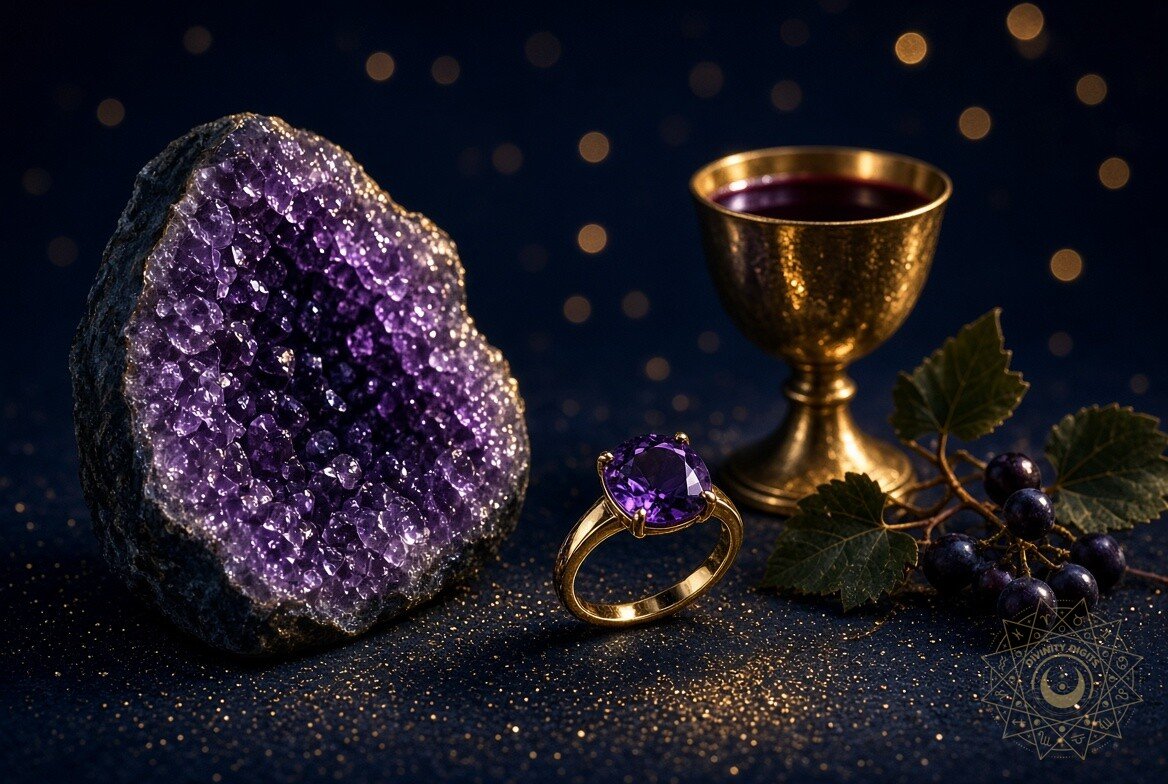
Amethyst typically forms in cavities in volcanic rock, where mineral-rich water deposits quartz crystals on the inner walls over long spans of time. A cavity lined with crystals is called a geode, and the great amethyst geodes of Brazil explain why the nineteenth-century discoveries mentioned above changed the market so sharply. A single large geode can contain more gem-quality purple crystal than a medieval treasury ever held.
The same growth habit shapes what you can buy. Because the crystals grow large, cutters can produce big, clean stones, and amethyst therefore appears in statement pieces that would be prohibitively expensive in ruby or sapphire. Size is cheap in amethyst and costly in the rarer stones, and that is the clearest practical difference between them.
Amethyst Across Traditions
The Christian tradition of the bishop’s ring often uses an amethyst, and the stone is sometimes called the bishop’s stone. The practice ties the sober, clear-headed meaning of the name to the office, and it is among the few amethyst customs we can document in continuous use.
In the Vedic jyotish tradition, amethyst, known in Hindi as jamunia, appears as a substitute stone, an uparatna, for the blue sapphire assigned to Saturn. We report this as a cultural practice. Readers who follow the system should know that the tradition treats amethyst as the less costly alternative, which fits the geological fact that amethyst is plentiful and blue sapphire is not. As with the garnet and hessonite tradition, no study shows that the substitute stone does anything for the wearer.
The Trade’s Names for Colour
Two names in the jewellery trade confuse buyers. “Siberian” describes a deep purple with flashes of red or blue, and sellers use it as a quality label. It does not guarantee that the stone came from Siberia. “Rose de France” describes a pale, soft lilac amethyst, and the term refers to colour, not origin. Both are marketing terms that sellers apply by eye. Ask what a seller means by them and do not treat either as a certificate.
Treatment: Heat, Citrine and Ametrine
Heat is the most common treatment for amethyst, according to GIA. It makes the colour permanent and can lighten very dark stones, but it cannot darken pale ones. Heat also changes more than depth. Some amethyst turns yellow when heated, and the result is citrine. Excessive heat can remove colour entirely, and it may make the stone somewhat more brittle.
The yellow outcome links February to the month that follows it in our series. Most citrine on the market began as amethyst, a point we develop in our guide to the November birthstone. A buyer who compares the two stones is comparing the same quartz at two stages of treatment.
Nature sometimes does the job without help. GIA describes ametrine as a naturally occurring bicolored amethyst and citrine from the Anahí mine, with purple and gold zones in one crystal. A stone sold as ametrine invites a question about origin, since treated or synthetic imitations exist.
Watch for: a cheap, vivid purple stone sold without a source. Synthetic amethyst exists, and a laboratory report is the only reliable way to separate a natural stone from a lab-grown one.
Telling Amethyst From Its Look-Alikes
Several purple or violet stones share amethyst’s colour, and a buyer should know which neighbours to doubt. The table sets out the usual confusions.
| Stone | How it differs from amethyst |
|---|---|
| Purple fluorite | Much softer, about 4 on the Mohs scale, so it scratches easily and suits display better than daily wear. |
| Tanzanite | Blue-violet with strong colour change between viewing angles, softer at 6 to 7, and far more costly. Our December birthstone guide covers it. |
| Iolite | Blue-violet and visibly pleochroic, showing different colours from different angles. |
| Glass or synthetic quartz | Can match amethyst closely by eye. Only a laboratory test settles it, which is why a report matters for valuable stones. |
The simplest defence is arithmetic. A natural stone with a documented source rarely sells at a very low price per carat, and a vivid purple stone at a bargain price should prompt a question about what it is. A reputable seller will name the stone, the treatment and the origin without hesitation.
Watch for: a stone described only as “purple gem” or “amethyst colour”. The wording leaves room for glass, and a seller who means amethyst will say amethyst.
What the Tradition Says
The tradition attaches sobriety, clear thinking and calm to amethyst. Modern crystal writing extends this to sleep, anxiety and intuition. Those later claims have no historical depth, and none has support from controlled study. We record them as cultural practice, the way a historian records the belief that a particular herb keeps away evil.
The sobriety claim deserves a direct comment because it is the one the name makes. Wearing a stone does not change what alcohol does to the body. The belief survives as a symbol of moderation, a reminder carried on the hand, and it is a harmless one as long as nobody treats it as a safeguard.
Durability and Care
| Property | What GIA reports |
|---|---|
| Hardness | 7 on the Mohs scale. Suited to daily wear, though it can show wear and may need repolishing. |
| Storage | Can scratch if stored near harder gems such as ruby, sapphire and diamond. Store separately. |
| Light | Some amethyst fades with prolonged exposure to strong light, so it is not ideal for constant outdoor wear. |
| Cleaning | A soft brush with mild soap is the gentle method. An ultrasonic cleaner is acceptable. GIA does not recommend steam cleaning. |
| Heat | Excess heat can remove colour. Keep it away from heaters, hot lamps and jewellery torches. |
A Buyer’s Short Method
- Judge colour in daylight. Look for even colour without pale or brown patches. Deep, saturated purple commands the highest prices.
- Ask about treatment. Heat is standard. Ask whether the seller heated the stone, and how.
- Ask about origin. A named source such as Bolivia, Zambia, Brazil or Arizona suggests a stone with a documented history.
- Request a report for a large or expensive stone, and for anything sold as ametrine.
- Match the setting to the lifestyle. A ring takes more knocks than a pendant, and a ring worn in strong sun may fade. Earrings and pendants avoid both risks.
Frequently Asked Questions
What is the February birthstone?
Amethyst, according to GIA. It is the purple variety of quartz.
Does amethyst really prevent drunkenness?
No. The name means “not intoxicated” in Greek, and ancient wearers believed the stone kept the head clear. Nothing about the stone affects how alcohol acts on the body.
Is amethyst always heat-treated?
Not always, but heat is the most common treatment. It deepens or fixes colour in some stones, and it can turn amethyst yellow, which produces citrine.
Does amethyst fade in the sun?
Some does. GIA notes that some amethyst fades with prolonged exposure to strong light. Store it out of direct sun and avoid wearing it outdoors every day.
How is amethyst different from citrine?
Both are quartz. Amethyst is purple, citrine is yellow to orange, and most citrine on the market began as heated amethyst. The November birthstone guide covers citrine in full, and the birthstone chart guide lists all twelve months.
So Is Amethyst the Right Stone for You?
Amethyst suits buyers who want a hard, plentiful, handsome gem at a reasonable price, and who accept that heat treatment is routine. Choose depth of colour over size, ask about origin, and keep the stone out of strong light. The birthstone calendar is a trade convention with a long history, and the meanings attached to each stone belong to tradition and marketing. No study shows that a birthstone predicts or changes anything. If a seller promises results, walk away. If you like the stone, wear it.
Sources
- GIA, February birthstones: the Greek name, Bacchus, sources, hardness, treatment, ametrine, light fading and care.
We could not verify at a primary source: the cause of amethyst’s colour (trace iron and natural radiation, standard mineralogy we did not re-read for this article), the Renaissance origin of the nymph legend, the bishop’s-ring and jamunia traditions, and the trade meanings of “Siberian” and “Rose de France”. We mark each as tradition or trade usage.
Last reviewed: 4 November 2026.
Discover more from Divinity Digits
Subscribe to get the latest posts sent to your email.