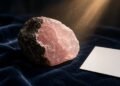
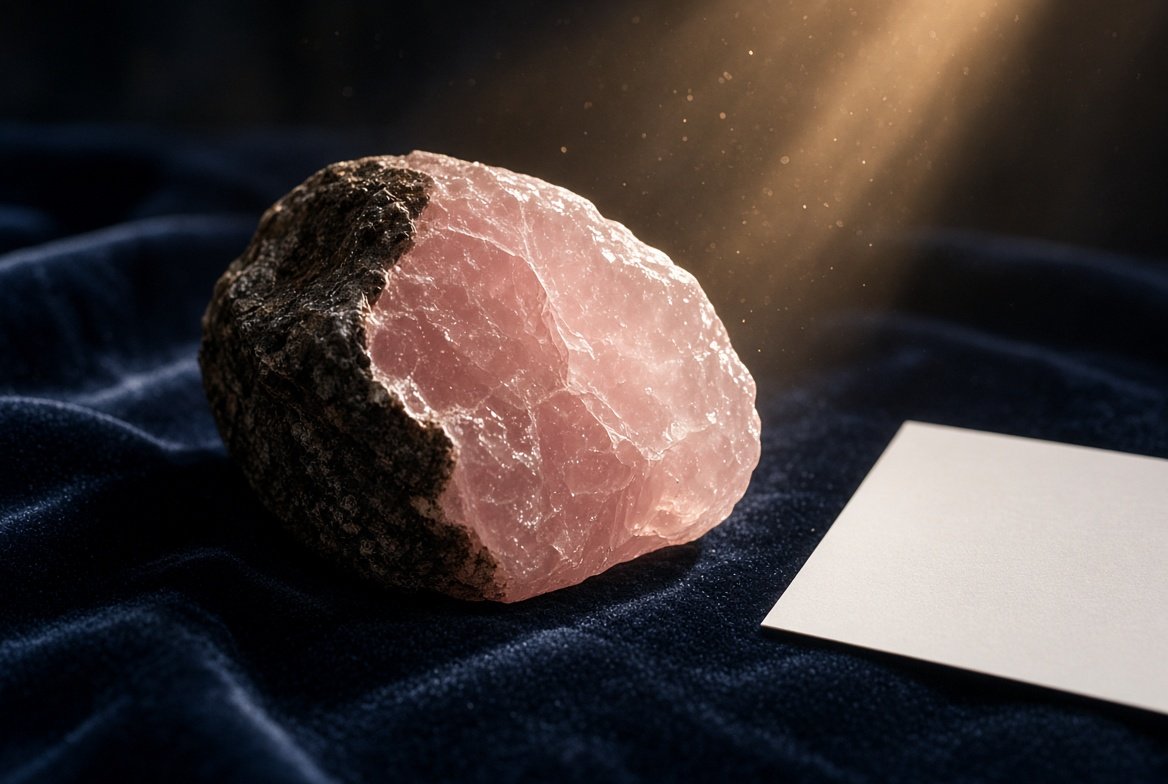
Rose quartz is pink because of tiny fibres, not because of the chemistry of the crystal itself. In 2001, researchers at Caltech pulled pink nanofibres out of rose quartz from 29 places around the world and found the same fibres everywhere. Each fibre is between 0.1 and 0.5 micrometres wide. That is the answer to the question this stone is usually asked: where does the pink come from? Modern crystal tradition calls rose quartz the stone of love. This guide separates what tradition says from what the mineralogy shows, reports where sources disagree on fading, and gives you a home test.
One detail first. Some rose quartz is reported to fade in sunlight, so the tradition of leaving stones in the sun may cost you the colour.
Rose Quartz: Key Facts
- Mineral: quartz, silicon dioxide, in a pink massive form
- Hardness: 7 on the Mohs scale, no cleavage, conchoidal fracture
- Cause of the pink: nanofibres of a dumortierite-like material, with iron and titanium charge transfer
- Tradition: modern crystal writing calls it the stone of love and emotional healing
- Oldest reported use: beads from about 7000 BC in Mesopotamia, according to GIA
What Does Rose Quartz Mean?
Crystals.com calls rose quartz the stone of unconditional love. That is how the modern tradition describes it. Retail and wellness pages repeat the claim widely, and none of the pages we read cite a test. The honest way to write it is: the tradition says rose quartz is about love, and the stone’s documented properties are colour, hardness and history.
Watch for: any page that says rose quartz heals a relationship or lowers anxiety as a fact. Our guides to crystals for anxiety and clear quartz use the same rule: tradition is labelled, evidence is separate.
Why Rose Quartz Is Pink
The 2001 paper by Julia Goreva, Chi Ma and George Rossman extracted pink fibres from rose quartz at 29 pegmatite and massive-vein sites. The fibres were 0.1 to 0.5 micrometres wide. Their X-ray patterns and optical behaviour best matched dumortierite, and the authors concluded that the fibres cause the colour of massive rose quartz worldwide. Redox and heating experiments tied the pink to iron and titanium exchanging charge, which absorbs light at about 500 nanometres. That removes green light and leaves the pink.
The fibres also scatter light, which is why most rose quartz is translucent, not clear. Geology.com notes that cut stones can show a six-rayed star when the fibres line up. Earlier writers blamed rutile needles. Wikipedia and the geology literature now treat the dumortierite-like fibres as the main cause.
Macroscopic Symptoms: A Timeline
- About 7000 BC: GIA reports rose quartz beads from Mesopotamia, now Iraq. We could not trace the dig record.
- About 800 to 600 BC: GIA says the Assyrians made rose quartz jewellery, and that the Assyrians and Romans may have been the first to use it.
- Ancient Rome: sources we read describe signet rings and carved gems, mostly on retail pages.
- 1987 to 2002: Applin and Hicks identify fibres of dumortierite in quartz, and Goreva, Ma and Rossman publish the 2001 colour study and a 2002 electron microscopy follow-up.
- 2023: Karen Fox and Andrew McDonald present continuing research on fading, asterism and the boron in the fibres.
Where Sources Disagree
- The fibre itself. The 2001 paper matches dumortierite. A later spectroscopy note says the phase may be a closely related material, not dumortierite itself. The field calls it dumortierite-like.
- Fading. Fox and McDonald list sunlight fading of rose quartz among their topics. The Wikipedia summary says massive rose quartz is stable and that rare transparent pink quartz is the photosensitive kind. A retail guide says rose quartz is notoriously sensitive to UV. These do not agree.
- Name. Gemologists say the rare transparent pink crystals have a different cause of colour and should be called pink quartz.
The Five-Point Binary Grid: What Checks Out
This grid is our own work, built from the sources above.
| Claim | Holds up? |
|---|---|
| The pink comes from nanofibres, not lattice impurities | Yes, for massive rose quartz (2001 study) |
| Hardness is 7 and it suits jewellery | Yes (GIA and Geology.com) |
| Rose quartz never fades | Disputed. Some sources report fading. |
| Beads from 7000 BC exist | Reported by GIA. We could not trace the source. |
| Rose quartz improves love or mood | No test in our sources |
Recorded Symptoms (Illustrative Composites)
These vignettes are invented to show how claims spread. They are not real buyers.
Composite A. A buyer leaves a rose quartz heart on a sunny windowsill to charge it. Months later the pink looks paler. She concludes the stone lost its energy. If some of it faded, the cause is light, and a simple test would show it.
Composite B. A seller says the pink comes from manganese and iron in the crystal. The Caltech paper points to fibres, not impurities in the lattice. The sentence sounds scientific and is wrong for massive rose quartz.
Insulation Protocols: A Home Fade Test
- Pick one piece of rose quartz. Photograph it against a white card in the same daylight.
- Cover half of it with black card or foil, and place it in a sunny window.
- Photograph it once a week for eight weeks, with the same card and light.
- Compare the covered half with the exposed half in the photos.
- Write down the result. Do the same with a second piece kept in a drawer as a control.
One stone proves little, but a visible split between covered and exposed halves would show light at work. No study shows rose quartz changes love, mood or luck, and our guide to cleansing crystals covers methods that avoid direct sun.
Frequently Asked Questions
What does rose quartz mean?
Modern crystal tradition calls it the stone of love and emotional healing. That is what the tradition says. No study in our sources tests whether it changes mood or relationships.
What makes rose quartz pink?
A 2001 American Mineralogist study found pink nanofibers in rose quartz from 29 localities. Their best match is dumortierite, a boron-bearing silicate. Their pink comes from iron and titanium exchanging charge, which absorbs light near 500 nanometres.
Does rose quartz fade in sunlight?
Some does. Karen Fox and Andrew McDonald list sunlight fading of rose quartz among the topics they are studying. Other summaries say massive rose quartz is stable and only rare transparent pink quartz fades. Keep it out of direct sun to be safe.
How hard is rose quartz?
It is 7 on the Mohs scale, with no cleavage, so it suits jewellery.
Is rose quartz the same as pink quartz?
Not always. Gemologists note that transparent pink quartz is rare and has a different cause of colour. Many want it called pink quartz, not rose quartz.
How old is the use of rose quartz?
GIA says beads dating to 7000 BC have been found in Mesopotamia and that Assyrian jewellery from about 800 to 600 BC used it. We could not trace the original excavation reports.
Aftermath: Where to Read Next
For another stone sold on meaning, read moonstone meaning. For the quartz family that rose quartz belongs to, see clear quartz meaning.
External Data Check
We checked the colour cause against the 2001 American Mineralogist abstract at Caltech and the abstract summary of its redox experiments. We checked hardness and the star effect against Geology.com, the history against GIA, and the fading discussion against the Fox and McDonald paper and the Wikipedia summary.
Sources
- Goreva, Ma and Rossman (2001), Fibrous nanoinclusions in massive rose quartz, American Mineralogist (Caltech record)
- Fox and McDonald, rose quartz fibre, fading and asterism research (IGC)
- Geology.com, Rose Quartz
- GIA, Rose Quartz History and Lore
- Wikipedia, Rose quartz
- Crystals.com, Rose Quartz complete guide
We could not verify: the excavation record behind the 7000 BC beads, the Roman and Egyptian claims on retail pages, whether massive rose quartz fades in ordinary sunlight, and any effect of the stone on love or mood. The grid and the fade test are our own work.
Last reviewed: 14 November 2026.
Discover more from Divinity Digits
Subscribe to get the latest posts sent to your email.