Around 1783, one French deck renamed the Emperor Grand Père, or Grandfather, and someone wrote L’Empereur at the bottom of the card to put the old name back. The card has been renamed, defended and reinterpreted ever since. In A. E. Waite’s list, the upright Emperor means stability, power, protection, realization, authority and will. Reversed, Waite lists benevolence, compassion and credit, plus confusion to enemies, obstruction and immaturity. Many modern pages call the reversed card tyranny instead. This guide checks the card against Waite’s text, the early Visconti decks and three Hebrew-letter systems.
One detail first. Waite’s reversed list opens with three gentle words: benevolence, compassion and credit. A common modern summary skips them.
The Emperor Tarot Card: Key Facts
- Number: IV, the fourth trump of the major arcana
- Waite’s upright keywords: stability, power, protection, realization; a great person; aid, reason, conviction; also authority and will
- Waite’s reversed keywords: benevolence, compassion, credit; also confusion to enemies, obstruction, immaturity
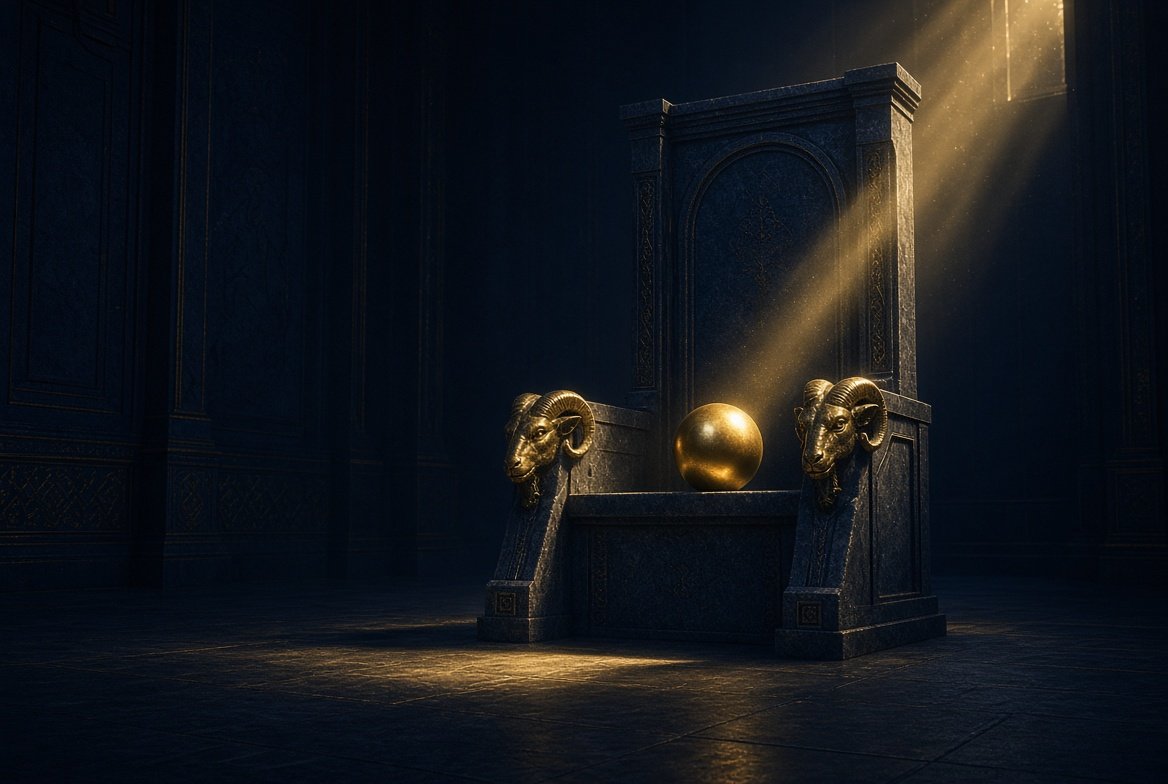
- Rider-Waite-Smith image (1909): a crowned monarch on a throne with rams’ heads on its arms, a crux ansata sceptre and a globe
- Earliest cards in our sources: the Visconti di Modrone Emperor (about 1441 to 1442) and the Visconti-Sforza Emperor (about 1450)
- Astrological tradition: Aries and Mars, with the Hebrew letter Heh, in the Golden Dawn system
What Does the Emperor Mean in Tarot?
In the Rider-Waite tradition, the Emperor stands for settled power. Waite calls him executive and realization, the power of this world, clothed with the highest of its natural attributes. That is a practical card: things get built, organised and defended. Waite also says this card and the Empress do not precisely represent married life, so the old reading of the pair as husband and wife is not his.
The Mechanics: What the Card Shows
Pamela Colman Smith drew the 1909 image under Waite’s direction. Waite describes a crowned monarch, commanding and stately, on a throne whose arms are fronted by rams’ heads. His sceptre is a form of the crux ansata, a cross with a loop for a handle, and he holds a globe in his left hand. Waite calls him the virile power to which the Empress responds, and says that in this sense he seeks to remove the Veil of Isis. He also reads the figure as the higher kingship on the intellectual throne, and he notes that the card has been called will in its embodied form, which he describes as only one of its applications.
Watch for: tyranny. It appears in neither of the keyword lists we have for Waite. The tyrant is a later figure.
Macroscopic Symptoms: The Card’s Paper Trail
- About 1441 to 1442: the Visconti di Modrone Emperor, the earliest in our sources. Tarot Heritage says it honours Emperor Sigismund, who died in 1437, and sets the card against the fifteenth-century struggle between the Holy Roman Emperor and the Pope.
- About 1450: the Visconti-Sforza Emperor shows an elderly, enthroned ruler against a gold ground.
- Mid-1600s: after deck production moves to France, the Emperor takes the Tarot de Marseille form that Tarot Heritage says stayed unchanged for centuries.
- About 1783: one deck renames him Grand Père, and someone writes L’Empereur on the card to restore the title.
- 1880s and 1890s: British occultists of the Golden Dawn shift the Hebrew alphabet along the cards, and the Emperor receives Heh, Aries and Mars.
- 1909: Smith and Waite follow the Golden Dawn closely and set rams’ heads on his throne.
The quiet clue is the title. For centuries he was a political figure, an emperor in a world that had a living one. The Golden Dawn made him a zodiac sign, and Waite’s deck made him a calm monarch with an Aries throne.
Where Sources Disagree
- Who the early emperor was: Tarot Heritage ties the Modrone card to Sigismund. A site on the Visconti-Sforza deck says that figure has not been securely identified with any ruler, and it notes that other scholars read him as an idealised type. We state no identification.
- The reversed card: Waite’s reversed list is benevolence, compassion and credit, with obstruction and immaturity. Wikipedia’s current summary says reversed means excessive control, tyranny or rigidity. Only one of the two is Waite.
- Waite’s keyword list itself: a Wikipedia keyword box credits Waite with authority, establishment, structure and a father figure. The longer list we cite appears in a mirror of an older Wikipedia version, which quotes Waite. We could not open the keyword section of the 1910 book, so our Waite wording is secondhand.
- The rams: Wikipedia says the ram heads stand for Aries. Waite’s passage that we read mentions the rams and does not name Aries, so we state only the rams.
One Card, Three Letters
The tradition links each trump to a Hebrew letter, and the Emperor’s letter moved. Three systems give three answers.
| System | Letter for the Emperor |
|---|---|
| Éliphas Lévi (19th century) | Daleth |
| Golden Dawn (1880s and 1890s) | Heh (Window), with Aries and Mars |
| Aleister Crowley (20th century) | Tzaddi |
Our Empress guide shows the other half of the swap. In Lévi’s system Daleth sits with the Emperor. The Golden Dawn gave Daleth to the Empress and gave the Emperor Heh, and Crowley later moved the Emperor again. Tarot writers argue over the reasons, and we report only the results. Llewellyn‘s encyclopedia lists all three letters, and Tarot Heritage describes the British shift to Heh, Aries and Mars. We have not read Lévi, the Golden Dawn papers or Crowley directly.
The Five-Point Binary Grid: The Emperor Upright and Reversed
This operational grid is our own diagnostic, not a traditional system. Waite’s words are the secondhand wording described above. The modern column follows a common summary, for example the one on Wikipedia.
| Spec | Upright | Reversed |
|---|---|---|
| Waite’s words | Stability, power, protection, realization; a great person; aid, reason, conviction; authority and will | Benevolence, compassion, credit; confusion to enemies, obstruction, immaturity |
| Common modern reading | Leadership, responsibility, structure, discipline | Excessive control, tyranny, rigidity, abuse of power |
| Direction | Build: something gets organised and defended | Mixed: kindness sits beside obstruction |
| Systemic friction | Waite’s upright list has no cautions, so the “rigid ruler” warning comes from elsewhere | The modern reversed card contradicts the gentler half of Waite’s list |
| Containment | Choose one rule or routine to set and put a review date on it | Check which source you are reading before you accept the verdict |
Recorded Symptoms
These are illustrative composites, not real case files.
Symptom 1. A reader draws the Emperor reversed before a meeting with his manager. A modern page says tyranny, so he walks in expecting a fight. Waite’s reversed list opens with benevolence and compassion. He chose the page that matched his dread, and the dread shaped the meeting.
Symptom 2. A reader draws the Emperor upright and takes it as licence to overrule her team. Waite’s text calls him executive and realization. It says nothing about overruling anyone, and she supplied that part herself.
Insulation Protocols: Using the Emperor on Your Terms
- Read Waite’s full lists first. Compare any page you read with the upright and reversed keywords.
- Check the reversed card against Waite. If a page says tyranny, note that Waite’s list does not.
- Name the deck. The Rider-Waite-Smith card shows rams’ heads. Older cards show a ruler in a political world. Their pictures prompt different readings.
- Turn the card into one small action. Pick one rule or routine to set, and review it in 30 days.
- Keep big decisions with real advice. No card can tell you whether to take a job, sign a contract or borrow money.
Plain note: no study shows that a tarot card predicts outcomes. If a reading worries you, stop and talk to a person.
FAQ
What does the Emperor mean in tarot?
In Waite’s list, the upright Emperor means stability, power, protection and realization, plus a great person, aid, reason, conviction, authority and will. Modern writers often shorten this to leadership, structure and discipline.
What does the Emperor reversed mean?
Waite lists benevolence, compassion and credit, plus confusion to enemies, obstruction and immaturity. Many modern pages say the reversed card means tyranny, rigidity or abuse of power. That is a later reading, and it contradicts the gentler half of Waite’s list.
What does the Emperor card show in the Rider-Waite deck?
A crowned monarch sits on a throne whose arms are fronted by rams’ heads. His sceptre is a form of the crux ansata, and he holds a globe in his left hand.
Which Hebrew letter belongs to the Emperor?
It depends on the tradition. The Golden Dawn gives him Heh, with Aries and Mars. Lévi gives him Daleth, and Crowley gives him Tzaddi.
Does the Emperor mean a father or a man in my life?
Waite’s list says a great person. Many modern pages add a father figure. That is a later gloss, and no card identifies a real person.
Is the Emperor my tarot year card?
No. Under the method on our year card calculator, birth month plus birth day plus 2027 reduces to a number from 5 to 17 only. The Emperor is number 4, so no birth date lands on him.
Aftermath
The tradition says the Emperor builds order. Waite’s own lists give him stability and protection when upright, and kindness mixed with obstruction when reversed. The tyrant is a modern figure, and neither version is evidence about your future. For the card before him in the sequence, see our guide to The Empress, and for how the deck got its images, see the history of tarot. For why a short list of traits can feel written for you, see our guide to the Barnum effect.
External Data Check
Popular summaries, including the current Wikipedia entry and a Bustle explainer, stress leadership, rules, order and structure, and Wikipedia says the reversed card means tyranny or rigidity. Waite’s lists, as we have them, do not. We sampled a few pages and did not survey the modern reading across many sites.
Sources
- Waite, The Pictorial Key to the Tarot, entry IV, The Emperor: a mirror of the Sacred Texts edition. Source for the image description and Waite’s commentary. This page does not include the keyword lists.
- Wikipedia, The Emperor (tarot card): the current modern summary, and, in an older mirror, the quoted Waite keyword lists.
- Tarot Heritage, L’Imperatore / The Emperor in Tarot: the early decks, the Marseille form, the Grand Père change and the Golden Dawn shift.
- The Morgan Library, Visconti Tarot Decks: the dating of the Visconti di Modrone Emperor.
- Global Spiritual Studies, Visconti-Sforza: The Emperor: the Visconti-Sforza card and the identification question.
- Llewellyn Encyclopedia, Emperor: the Lévi, Golden Dawn and Crowley letters.
- Bustle, Emperor tarot card meaning: one example of the modern reading.
We could not verify: the Waite keyword lists at the 1910 text itself, the Lévi, Golden Dawn and Crowley attributions at their original sources, the identity of the figure on the Visconti cards, and which deck carried the Grand Père title. The keyword counts and grid are our own work.
Last reviewed: 14 November 2026.
Discover more from Divinity Digits
Subscribe to get the latest posts sent to your email.