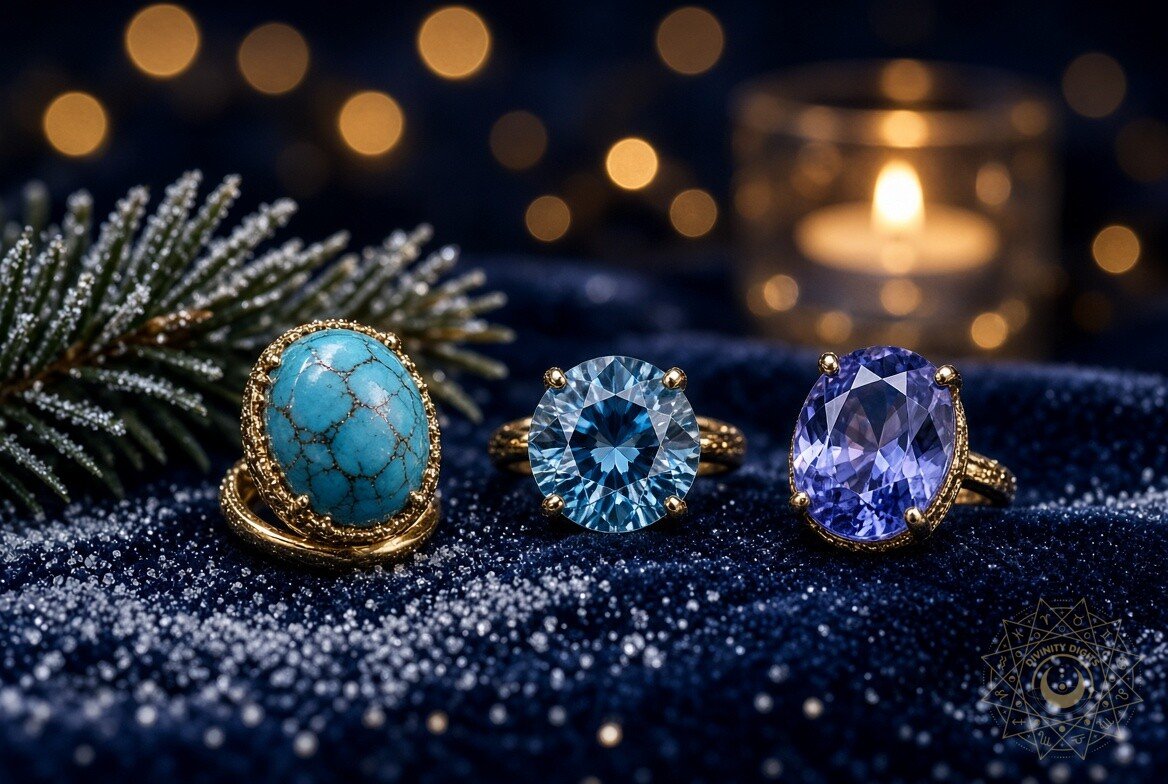
December has more official birthstones than any other month, and the newest one has no ancient history at all. Gemologists identified tanzanite as a mineral in 1962, and it has one known source, a patch of hills in northern Tanzania. People have worn turquoise for thousands of years. Zircon is among the oldest minerals on Earth. Three stones, three very different pasts, and a popular fourth that the official list leaves out.
As with every topic here, none of this is scientifically validated. No controlled study has found that a gemstone changes a person’s health, luck, or personality. What follows separates documented history from tradition and flags the folklore.
Why Does December Have Three Birthstones?
GIA’s birthstone guide lists three December stones: tanzanite, turquoise and zircon. The page does not list blue topaz, although many jewelers sell it as a fourth option. Our November birthstone guide covers blue topaz and how much of it is natural.
The list grew in steps. The US jewelers’ list of 1912 named turquoise for December, and some accounts add lapis lazuli as an alternate. According to National Jeweler, zircon joined in 1952 and tanzanite in 2002. Sources differ on which trade body made the 2002 change, with some crediting Jewelers of America and others the American Gem Trade Association. For the wider picture, see our birthstone chart guide.
Turquoise: The Stone That Absorbs Everything
Turquoise is a hydrated copper aluminum phosphate. Copper gives it the blue, and iron can push it toward green. It forms when groundwater moves through aluminous rock near copper deposits. GIA notes that Egyptian pharaohs wore it and that Chinese artisans were carving it more than 3,000 years ago. The mines of Iran’s Nishapur district have produced it for over 1,000 years.
The tradition links turquoise to protection, a belief tied to Egyptian amulets. That is folklore, and no test supports it. The physical facts are more useful. Turquoise rates 5 to 6 on the Mohs scale and is porous, so it absorbs skin oils, perfume and lotions, which can darken it or shift blue toward green.
Watch for: sellers stabilize most turquoise on the market, meaning they harden the stone with resin or a similar filler. That is an accepted trade practice if disclosed. Sellers also market dyed howlite and magnesite under names such as white turquoise, and they are not turquoise. Ask for the treatment in writing.
Zircon: Not Cubic Zirconia
Zircon is a natural zirconium silicate. Cubic zirconia is a different material, a lab-made zirconium oxide sold as a diamond simulant. The names are close, which is why buyers confuse them. Researchers have dated zircon crystals from Jack Hills in Western Australia to about 4.4 billion years, among the oldest minerals known.
The blue zircon in jewelry is almost always heat-treated brown stone. GIA says zircon’s blue is almost always the result of heat treatment. The treatment is standard, but the stone pays for it. Zircon is brittle, it chips along its facet edges, and GIA notes it is hard to cut. Some heat-treated gems can also revert toward their original color after long exposure to bright light.
Tanzanite: The Newest Birthstone
Tanzanite is the blue-violet variety of the mineral zoisite. GIA reports that gemologists identified blue stones from Tanzania as zoisite in 1962 and that prospectors located the Merelani Hills source in 1967. It remains the only known commercial source.
Sellers heat most tanzanite. Raw zoisite from Merelani is often brownish, and heating to roughly 400 to 500 degrees Celsius removes the brown and deepens the blue. The result is permanent. A small share of tanzanite is naturally blue without heating. Tanzanite is also strongly pleochroic, which means it shows different colors from different angles: blue, violet and a brownish-yellow.
Modern retail writing links tanzanite to transformation. A stone first marketed in the 1960s has no ancient lore, so treat that link as recent branding, not tradition.
How the December List Grew: A Timeline
December’s stone has changed more than any other month’s, and the order of changes shows how a trade convention forms. Accounts differ on details, so we mark where sources disagree.
| Period | What happened |
|---|---|
| Early lists | Gem lists inspired by the Biblical breastplate assigned ruby to December in some versions, according to one gem dealer’s history of the list. |
| 1870 | Tiffany and Company published a pamphlet of birthstone verses that named turquoise for December. |
| 1912 | The US jewelers’ association standardised the modern list with turquoise for December. Some accounts add lapis lazuli as an alternate; sources differ. |
| 1952 | Zircon joined when the Jewelry Industry Council of America updated the list, according to National Jeweler. |
| 2002 | Tanzanite joined. Sources credit either Jewelers of America or the American Gem Trade Association. |
The pattern repeats across months: the list adds stones when a trade body wants to give buyers a cheaper or more available option, or to promote a new find. Tanzanite is the clearest case. Prospectors located its source in 1967, and it joined the list within about thirty-five years. We offer this as a description of how lists evolve, and not as an accusation. A convention that merchants built will reflect what merchants sell.
Turquoise by Origin
Turquoise varies more by locality than the other December stones, and buyers use origin as a rough guide to appearance. The descriptions below come from trade references and they describe tendencies, not guarantees.
| Origin | Typical appearance |
|---|---|
| Iran (Persian) | Classic sky blue, sometimes with a golden limonite matrix. The Nishapur district has produced turquoise for over 1,000 years, according to GIA. |
| Arizona, United States | Clean blue with reddish-brown or little matrix. The Sleeping Beauty and Kingman types come from here. |
| Nevada, United States | Often shows green tones and a spiderweb matrix. |
| Hubei, China | Sky blue to robin’s-egg with brown or black matrix. Sellers favour it for calibrated bead sizes because it is consistent. |
A note on matrix, the host rock that threads through some stones. Collectors generally discount stones with dark matrix, but one pattern, a fine spiderweb of veins, earns a premium in particular localities. Whether a veined stone is a flaw or a feature depends on the market and on taste, which makes it a useful reminder that value in gemstones is partly cultural.
Tanzanite’s Narrow Source
Tanzanite has a single known commercial source, the Merelani Hills in northern Tanzania, and at least one account puts the entire commercial supply within an area of about four kilometres square. That concentration has two consequences. It leaves tanzanite exposed to supply disruption, and it means every stone’s story begins in one small district. A seller who names another origin for tanzanite deserves a polite question.
Its pleochroism, the display of different colours from different angles, also affects buying. Cutters orient the stone to show the best blue, and a stone that looks violet in one light may look blue in another. Judge colour under daylight and under the lamp you will use at home.
A Fact About Zircon That Surprises Buyers
Zircon sometimes contains traces of uranium. GIA states that it can be very slightly radioactive, at levels that pose no health risk when used in jewelry. The fact fascinates and sometimes alarms buyers, and the honest summary is that the level is trivial. The same uranium also lets geologists date zircon crystals, which is how the Jack Hills crystals earned their age of about 4.4 billion years.
A Short Buying Checklist
- Turquoise: ask whether the stone is natural, stabilised or reconstituted, and ask for the origin. Avoid stones sold only as “turquoise colour”.
- Zircon: ask whether the colour comes from heat treatment, which is standard for blue zircon, and confirm that the seller means zircon and not cubic zirconia.
- Tanzanite: ask about heat treatment, confirm the stone is not a lookalike such as coated or dyed material, and view it in more than one light.
- All three: choose a setting that protects the stone, and ask the seller to put the treatment details in writing.
Caring for December’s Stones
| Stone | Mohs hardness | Main weakness | Care |
|---|---|---|---|
| Turquoise | 5 to 6 | Porous, absorbs oils and chemicals | Wipe with a soft damp cloth. No ultrasonic or steam. |
| Zircon | 6 to 7.5 | Brittle, chips at the edges | Warm soapy water. Avoid knocks and long bright light. |
| Tanzanite | 6 to 7 | Fair to poor toughness | Warm soapy water. Protect from hard impacts. |
None of the three suits a ring worn every day. Earrings and pendants carry less risk. If you want a hard blue stone for daily wear, blue topaz at 8 on the Mohs scale is harder than all three, though it is not on GIA’s list.
Frequently Asked Questions
What is the real December birthstone?
GIA lists tanzanite, turquoise and zircon. Turquoise has the longest record as a worn stone and is the one most people call traditional. Jewelers widely sell blue topaz as a December stone but was not on the GIA page we checked.
Is zircon the same as cubic zirconia?
No. Zircon is a natural mineral. Cubic zirconia is a lab-made zirconium oxide. A reputable seller will say which one you are buying.
Is tanzanite naturally blue?
Usually not. The vast majority of tanzanite is heat-treated to turn brownish zoisite blue or violet. The treatment is permanent and standard, and sellers should still disclose it.
Does turquoise really protect the wearer?
The tradition says so, and the belief is ancient. No controlled study supports a protective effect. Wear it because you like it.
Which December stone lasts longest?
None is tough. Zircon and tanzanite sit around 6 to 7 on the Mohs scale, and turquoise is softer and porous. Zircon is brittle, tanzanite has fair to poor toughness, and turquoise absorbs oils. Pick a protective setting and avoid daily ring wear.
So Which December Birthstone Should You Choose?
Choose turquoise for history, zircon for brilliance and tanzanite for color, and ask for treatment details in every case. The list is a trade convention, built by jewelers over a century, not a rule of nature. The meanings attached to each stone are tradition and marketing, and no study shows that a birthstone predicts or changes anything. If a seller promises results, walk away. If you like the stone, wear it.
Sources
- GIA, December birthstones: the three official stones, tanzanite’s 1962 and 1967 dates, hardness figures.
- GIA, zircon quality factors and the GIA zircon buyer’s guide: heat treatment, brittleness and trace radioactivity.
- Bocchio, R. and others (2012). Gem-quality zoisite from Merelani, Periodico di Mineralogia 81(3): heat treatment of tanzanite.
- National Jeweler, how the modern birthstone list came to be: the 1952 and 2002 changes.
- Gem Rock Auctions, December birthstone timeline: the 1870 and 1912 lists (a dealer’s account, used for dates only).
- Trade references for turquoise origins, treatment and care, used for market practice and not as proof: USA Jewels and Dakota Stones.
We could not verify at a primary source: whether lapis lazuli sat beside turquoise on the 1912 list, which trade body added tanzanite in 2002, and the “four kilometres square” figure for tanzanite’s source, which comes from a single consumer account. We flag each in the text.
Last reviewed: 3 November 2026.
Discover more from Divinity Digits
Subscribe to get the latest posts sent to your email.