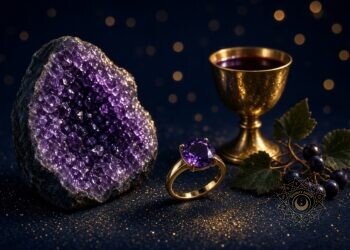

Amethyst tops nearly every list of the best crystals for sleep. It’s tucked under a pillow or set on a nightstand for its supposedly calming energy. Meanwhile, sleep researchers have identified something in most bedrooms that demonstrably delays the body’s sleep hormone by over an hour. It isn’t a crystal. It’s a phone screen. Both claims are worth taking seriously, just not for the same reasons.
It’s worth saying plainly, same as with any topic here: none of this is scientifically validated. No controlled study has found that a crystal changes sleep quality, hormone levels, or brain activity. What follows describes the real, widely practiced tradition around crystals for sleep. It’s paired with the actual research on what does measurably affect a night’s rest.
The Crystals Practitioners Recommend for Sleep
Amethyst leads nearly every list, and by a wide margin. Mindbodygreen’s roundup quotes crystal expert Heather Askinosie describing it as “a wonderful crystal to sleep with.” She adds that it has “a softer energy that helps to create a calm, soothing environment” compared to more “active” stones. Celestite is the other most-cited option, credited by the same source with bringing “tranquillity and a harmonious energy field.”
Several other stones show up specifically for dreamwork rather than general calm. Moonstone is described as supporting “meaningful dreams” and intuition. Labradorite gets paired with invocations for dream recall. Selenite, a form of gypsum named for the Greek moon goddess Selene, is recommended as an energy-clearing stone to place under the pillow. Black tourmaline is recommended specifically for people dealing with nightmares or restless sleep, credited with a grounding, protective effect. Smoky quartz gets a similar grounding, protective association, recommended more generally for a stabilizing presence in the bedroom.
None of these pairings rest on a tested mechanism. They’re drawn from color association, mineral symbolism, and practitioner tradition. It’s the same framework this site has covered for how crystals get matched to anxiety, birth months, and zodiac signs.
How the Recommended Sleep Crystals Actually Compare
Tradition treats these stones as roughly interchangeable, mood-wise, but their physical properties are genuinely different, and that’s worth knowing before choosing where to keep one overnight. Amethyst and smoky quartz are both varieties of ordinary quartz, silicon dioxide, and share quartz’s Mohs hardness of 7, durable enough for nightly handling. Celestite, despite its similarly delicate reputation, is a much softer strontium sulfate mineral, rating only 3.0 to 3.5. Moonstone and labradorite both belong to the feldspar group and sit in the middle, around 6.0 to 6.5. Selenite is the outlier by far. As a form of gypsum, it rates just 1.5 to 2, among the softest minerals sold as jewelry, and it’s genuinely water-soluble rather than merely delicate in a spiritual sense. Black tourmaline, chemically known as schorl, is the toughest of the group at 7.0 to 7.5.
Mineral Family and Hardness, Side by Side
| Crystal | Mineral Family | Mohs Hardness | Practical Note |
|---|---|---|---|
| Amethyst | Quartz (silicon dioxide) | 7 | Durable, but color can fade with prolonged direct light |
| Smoky Quartz | Quartz (silicon dioxide) | 7 | Durable for daily handling |
| Black Tourmaline | Schorl (boron silicate) | 7.0–7.5 | The hardest of this group |
| Moonstone | Feldspar | 6.0–6.5 | Moderately durable, avoid rough handling |
| Labradorite | Feldspar | 6.0–6.5 | Moderately durable, avoid rough handling |
| Celestite | Strontium sulfate | 3.0–3.5 | Soft and brittle, handle gently |
| Selenite | Gypsum | 1.5–2 | Water-soluble, keep away from moisture |
That last point matters in practice. Selenite dissolves gradually with repeated water exposure, since gypsum is a moderately water-soluble mineral. Keeping a selenite piece on a dry nightstand rather than a humid bathroom counter isn’t superstition. It’s the same physical chemistry that applies to any water-soluble mineral, sleep-related or not.
Is There Any Science Behind Sleep Crystals?
No. Wikipedia’s entry on crystal healing classifies the broader practice as a pseudoscience. It notes there is “no peer-reviewed scientific evidence that crystal healing has any effect.” That verdict applies as much to a crystal on a nightstand as to one used for any other stated purpose. There’s no measured energy field for the stone to be calming, clearing, or protecting in the first place.
That doesn’t mean the ritual accomplishes nothing. Setting a stone down, dimming the lights, and settling into a fixed pre-sleep routine can function as a cue to the body that it’s time to wind down. That’s a real effect. It just isn’t coming from the mineral itself.
What Actually Affects Your Sleep at Night
Here’s the part most crystal guides skip, and it’s the one with genuine research behind it. Sleep Foundation, reviewed by a board-certified sleep medicine physician, explains that electronic devices emit blue light. That light “has been shown to reduce or delay the natural production of melatonin in the evening.” One cited study found that bright bedroom lighting delayed nocturnal melatonin production by as much as 90 minutes compared to dim lighting. Blue light can also cut into time spent in slow-wave and REM sleep specifically. Those are the deeper stages tied to feeling rested the next day.
The mechanism is light exposure itself, not any particular device or app. Sleep Foundation notes that normal indoor light levels of 100 lux or more can suppress melatonin on their own. Red, yellow, and orange light, by contrast, have little to no measurable effect on the body’s circadian rhythm. That’s the real, evidence-backed reason a warm-toned lamp is a better bedside choice than a bright phone screen.
Sleep Foundation’s practical recommendation is straightforward: keep the hour before bed free of screens, dim the bedroom lights, and build a consistent wind-down routine. Every part of that advice is testable and has been tested. A crystal placed nearby doesn’t hurt anything. It just isn’t what’s doing the measurable work.
The Research Behind the “90-Minute Delay” Finding
That 90-minute figure traces back to a specific, peer-reviewed study, not a rounded-off estimate. Researchers Gooley and colleagues published the finding in the Journal of Clinical Endocrinology & Metabolism in 2011. They measured how room light exposure before bedtime affected melatonin onset. Sleep Foundation cites it directly as the source for the claim that bright bedroom lighting can delay nocturnal melatonin production compared to dim lighting.
A separate, more applied study tested whether blocking blue light specifically could help people who already struggle to fall asleep. Shechter and colleagues ran a randomized controlled trial, published in 2018 in the Journal of Psychiatric Research. It tested blue-light-blocking glasses against a placebo in people with insomnia. A randomized controlled trial is a meaningfully stronger form of evidence than the anecdotal reports that support most crystal claims. It compares a real intervention against a matched placebo, rather than relying on how participants say they felt afterward. That’s the same evidentiary bar crystal healing has never cleared, in this study or any other.
Frequently Asked Questions
What are the best crystals for sleep?
Amethyst, according to most crystal guides and practicing experts, with celestite a close second. That reflects tradition and popularity, not tested effectiveness. No study has found a measurable sleep difference between amethyst and any other object placed on a nightstand.
Isn’t it convenient that “sleep crystal” advice mostly matches basic bedtime hygiene?
Fairly, yes, and it’s worth naming directly. Dimming lights, calming the room, and following a consistent routine are genuinely useful, evidence-backed habits. Crediting a specific stone for that benefit, rather than the routine itself, is the part that doesn’t hold up when tested.
Do crystals actually improve sleep quality?
Not according to any controlled research. The pseudoscience classification that applies to crystal healing generally applies here too. Anyone who feels calmer with a crystal nearby is likely responding to the ritual and routine around it, not a property of the mineral.
Does blue light from a phone really delay sleep that much?
Research says yes, meaningfully. One cited study found a delay of up to 90 minutes in melatonin production from bright bedroom lighting alone. That’s a substantially larger, more measurable effect than anything claimed for any crystal.
Can crystals replace good sleep habits or treat insomnia?
No, and no credible source claims otherwise. Crystals are, at best, a low-stakes addition to an existing bedtime routine. Ongoing sleep problems, including insomnia, are worth bringing to a doctor rather than addressing with a stone alone.
The Honest Answer
Amethyst and celestite win the popularity contest for sleep crystals, and there’s no harm in keeping one on a nightstand if the ritual feels good. The research just points somewhere else entirely: toward the amount and color of light in a room in the hour before bed, not toward any mineral in it. Dim the lights, put the phone down, and treat a crystal as part of that wind-down cue rather than the mechanism itself. The practice holds up fine on its own terms.
For the research behind another common reason people reach for a crystal, Best Crystals for Anxiety: What the Research Actually Found breaks down a closely related claim. And for a look at how a crystal’s condition connects to its perceived power, Are Your Crystals Dead? Signs They’ve Lost Their Power covers that angle directly.
Discover more from Divinity Digits
Subscribe to get the latest posts sent to your email.