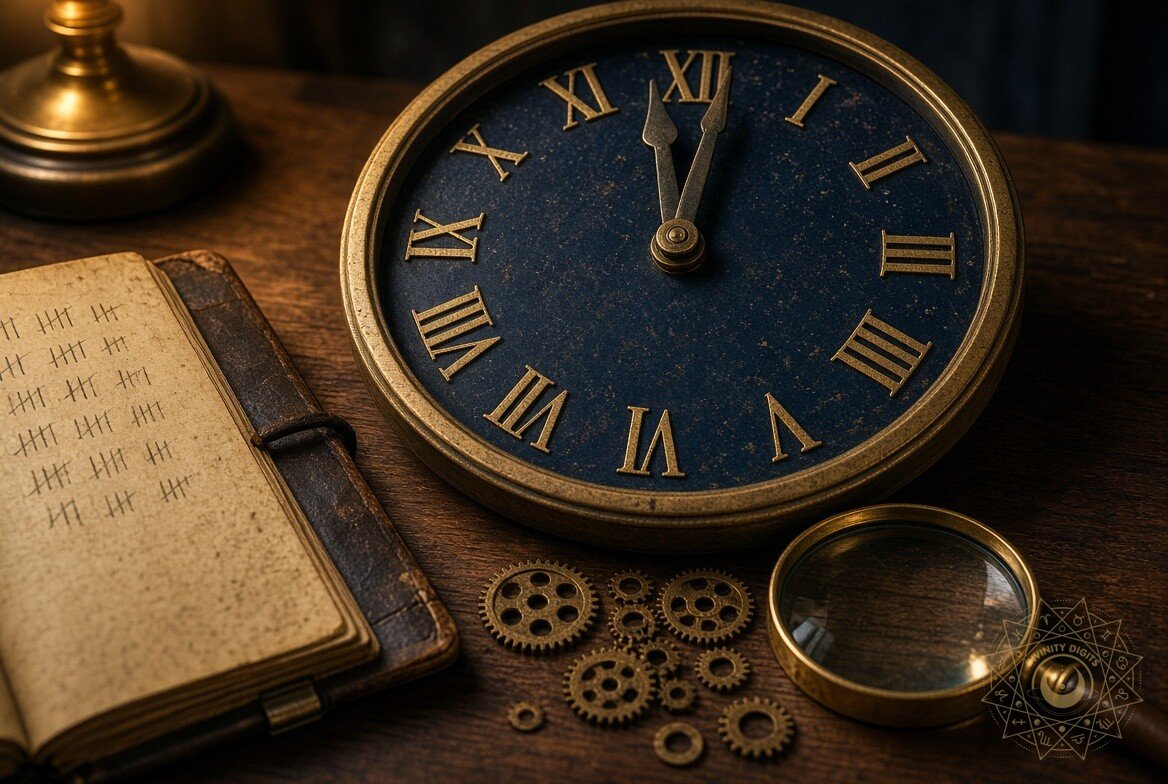
A 12-hour clock shows 12:12 twice every day, whether anyone is watching or not. That one fact frames every claim about this number, so we start with it and then give you the tradition.
The short answer
The angel-number tradition reads 1212 as a sign of new beginnings, balance and partnership, with a push toward spiritual growth. That is what the tradition says. No study shows that a repeating number carries a message. The rest of this article shows where the reading comes from, how the digits add up, and how often you should expect to see the number by chance.
The arithmetic
The digits of 1212 add to 6 (1 + 2 + 1 + 2 = 6). The pair 12 reduces to 3 (1 + 2 = 3), and 3 + 3 also gives 6. Both routes end at 6, the number that Pythagorean numerology links with harmony and responsibility. Many angel-number pages build their reading from this: 1 stands for beginnings, 2 for partnership, and the repeat adds emphasis.
Chaldean numerology reads compound numbers such as 12 separately from their single-digit root, and sources differ on what each compound means. Our guide to Chaldean compound numbers shows how that system works and why its readings can differ from the angel-number versions.
Where “angel numbers” came from
The phrase is recent. Most sources credit the author Doreen Virtue, whose book Angel Numbers appeared from Hay House in April 2005. It is a reference book that lists messages for number sequences, and it presents the meanings as received from angels. The idea that numbers carry meaning is much older, but the label, the lookup-book format and the habit of treating a repeat sighting as a message trace back to that period. Dictionary.com notes that use of the term grew steadily after the book’s release.
Our own count: how often do “pattern” times appear?
We counted every minute on a 12-hour clock display (1:00 to 12:59, 720 minutes) and flagged four kinds of pattern. The count is our own calculation, and the categories are our own definition.
| Pattern | Example | Minutes per 12 hours |
|---|---|---|
| Same digit | 3:33, 11:11 | 6 |
| Repeated pair | 12:12, 10:10 | 3 |
| Mirror (reads the same backward) | 2:12, 12:21 | 57 |
| Straight sequence | 1:23, 12:34 | 5 |
| Any of the above | 64 (8.9%) |
Some times fit two categories, so the rows add to more than 64. The 64 counts each minute once. Over a full day that is 128 pattern minutes. The exact time 12:12 is only 2 minutes out of 1,440 (about 0.14%).
Now assume you glance at a clock ten times a day at random moments. The chance of seeing at least one pattern time is about 61% (1 minus 0.911 to the tenth power). Real glances are not random, so treat this as a rough model. It still shows that “I keep seeing a pattern” is the expected result.
Why the number feels targeted
Psychologists and linguists call this the frequency illusion. Once you notice something, you spot it more often and conclude it has become more frequent. The name came from the linguist Arnold Zwicky, who wrote about it on the Language Log blog in August 2005. He attributed it to two processes: selective attention, which notices what you are looking for, and confirmation, which keeps the hits and forgets the misses. The popular name, the Baader-Meinhof phenomenon, dates to a 1994 letter by Terry Mullen to the St. Paul Pioneer Press.
Apply that to 12:12. You see it once, it feels meaningful, and from then on you check the clock slightly more at the right moments and remember the hits. Nothing changed except your attention.
Watch for: the point where a number reading replaces a decision. The tradition treats 1212 as encouragement, not a forecast, and it cannot tell you whether to change jobs, end a relationship or spend money. Use the reading as a prompt to review your own plans, and decide on the facts.
Where sources disagree
Angel-number sites agree on the broad themes (beginnings, balance, partnership) and then diverge. Some add love and twin-flame readings, some add biblical readings based on the number 12, and some assign 1212 to career change. These additions are interpretation, and no source we found gives evidence for them. We report the shared core and leave out the rest.
FAQ
Does 1212 predict anything? No. The tradition reads it as a message of encouragement. No study shows that repeating numbers predict events.
Why do I see 12:12 so often? A 12-hour clock shows it twice a day, and you are more likely to notice it after you start looking. That is the frequency illusion.
Is 1212 a Master Number? No. The Master Numbers are 11, 22 and 33. Our article on where Master Numbers came from covers the history.
Who invented angel numbers? The term is usually credited to Doreen Virtue’s 2005 book. The underlying belief in meaningful numbers is much older.
Sources and how we checked
- Doreen Virtue, Angel Numbers (Hay House, April 2005): publication date checked against the Goodreads listing.
- Dictionary.com, “angel number”: credits Virtue’s 2005 book and notes the growth in use of the term.
- Wikipedia, “Frequency illusion”: the Mullen 1994 letter, Zwicky’s 2005 coinage and his two-process explanation. We could not open the Language Log post itself, so that attribution rests on this reference page and a second source.
- Clock table: our own calculation, run in code across all 720 minutes. Pattern definitions are ours.
We could not verify any claim that 1212 predicts events, and we make none.
Last reviewed: 11 November 2026.
Discover more from Divinity Digits
Subscribe to get the latest posts sent to your email.