The first numbered card in the deck was a street performer. In the Tarot de Marseille, trump number I is Le Bateleur, a mountebank working a table of tricks. The modern Magician tarot card meaning, will and skill, arrived later, when occultists turned the conjurer into a magus. By our count, none of the 366 possible birthdays draws it as a tarot year card for 2027, because that method only reaches cards 5 to 17. Here is what the tradition says, and where it stops.
The Mechanics: What the Card Shows
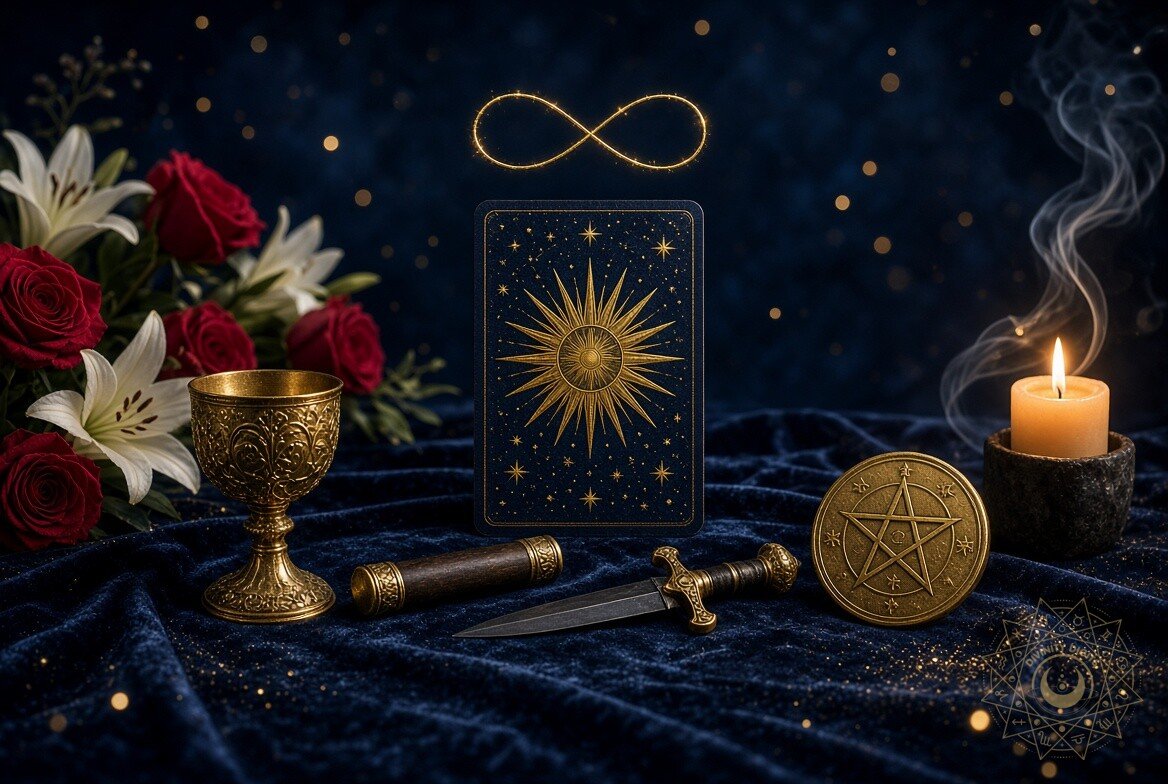
The Magician is the first numbered trump, and the Magician tarot card meaning starts with its picture. In the Rider-Waite-Smith image, drawn by Pamela Colman Smith, a young figure in a white robe and red cloak stands at a table. A.E. Waite describes a wand raised toward heaven in the right hand while the left hand points to the earth. A lemniscate, the infinity sign, floats above his head. A serpent circles his waist with its tail in its mouth. On the table lie the symbols of the four tarot suits, and roses and lilies grow below. Waite reads the flowers as the culture of aspiration.
Watch for: the four suit symbols sit on the table, not in his hands. The tradition says that is the point. The table holds the tools, and he has used none of them yet.
Macroscopic Symptoms: The Card’s Paper Trail
- About 1460: painted cards attributed to Bonifacio Bembo, in the Visconti-Sforza style, show Il Bagatto apparently playing with cups and balls. The card began as a trickster.
- Marseille pattern: Le Bateleur, the mountebank, holds a wand and works a table of objects. For the full lineage, see our history of tarot.
- Occult reinterpretation: starting with Oswald Wirth, occultists recast the mountebank as a magus. The trickster became an adept.
- 1910, Waite: his Pictorial Key to the Tarot lists, upright, skill, diplomacy, address, subtlety, self-confidence and will. The same entry lists sickness, pain, loss, disaster and snares of enemies. Reversed, it lists physician, Magus, mental disease, disgrace and disquiet.
- Golden Dawn: the order called the card the Magus of Power and linked it to Mercury, the planet of messages and trade. The tradition pairs it with the Hebrew letter Beth.
- Thoth: Aleister Crowley and Lady Frieda Harris painted their deck between 1938 and 1943. Their version carries the title The Magus.
The Five-Point Binary Grid: Magician Tarot Card Meaning, Upright and Reversed
This operational grid is our own diagnostic, not a traditional system.
| Spec | Upright | Reversed |
|---|---|---|
| Direction | Effort aimed at a target | Effort with no target, or a false front |
| Waite’s words | Skill, diplomacy, address, subtlety, will | Physician, Magus, disgrace, disquiet |
| Kinetic energy | High: the tools are on the table | Low or scattered: tools out, nothing built |
| Systemic friction | Comes from overconfidence | Comes from the gap between claimed and actual skill |
| Containment | Pick one tool and finish one task | Audit what you claim against what you can do |
Recorded Symptoms
These are illustrative composites, not real case files.
Symptom 1. A freelancer draws the Magician and reads it as permission to launch five projects at once. None ships by the end of the month. The card says skill and will. It does not say sequence.
Symptom 2. A salesman draws the Magician reversed before a pitch and reads it as a warning about deceit. He rehearses with a colleague and cuts two claims he cannot support. The card fit, but the rehearsal did the work.
Insulation Protocols: Using the Magician on Your Terms
- Separate skill from show. Write what you can already do today, then what you only hope to do.
- Pick one tool from the table. Cup, wand, sword or pentacle: choose the one that fits the task and set the rest aside.
- Read the whole entry. Waite’s list includes sickness, pain and loss next to skill. Someone has edited any version of the card that only flatters.
- Set a review date 30 days out with one measurable check.
- Do not redraw. Drawing again until the card is comfortable is extraction of false reassurance.
Plain note: no study shows that a tarot card predicts outcomes. If a reading worries you, stop and talk to a person.
FAQ
What does the Magician mean in tarot?
In Waite’s 1910 list the upright card means skill, diplomacy, address, subtlety, self-confidence and will. Modern writers compress this to manifestation and resourcefulness. That is a later gloss, not Waite’s wording.
What does the Magician reversed mean?
Waite lists physician, Magus, mental disease, disgrace and disquiet. Modern readers usually read the reversed card as skill without ethics, or potential without action. Both describe effort that has lost its aim.
Is the Magician a good or bad card?
The tradition does not sort it that way. Waite’s upright entry mixes strengths (skill, will) with losses (sickness, pain, disaster). The picture is neutral. The reading depends on what you do with the table.
Which planet and sign belong to the Magician?
Mercury, in the Golden Dawn attribution. Some modern writers add Gemini and Virgo, the two signs Mercury rules.
Is the Magician my tarot year card?
No. Under the method on our year card calculator, birth month plus birth day plus 2027 reduces to a number from 5 to 17 only. Cards 0 to 4 and 18 to 21 are out of reach for every date. Use the year card calculator to find yours.
The Card Across Four Decks
The Magician has changed more than almost any other trump, and the changes tell a story about who used the cards and why. Four decks mark the main stages.
| Deck | Title | What the picture shows |
|---|---|---|
| Visconti-Sforza (about 1460, attributed to Bonifacio Bembo) | Il Bagatto | A performer who appears to play with cups and balls, among the oldest conjuring routines on record. |
| Tarot de Marseille (from the seventeenth century) | Le Bateleur, the mountebank | A figure at an outdoor table of objects, wide-brimmed hat, wand held in one hand. The hat suggests the later infinity sign without quite drawing it. |
| Rider-Waite-Smith (1909) | The Magician | A robed adept with a wand raised in the right hand, the left hand pointing down, the lemniscate above his head and the four suit symbols on the table. Waite reversed the arm positions of the Marseille figure. |
| Thoth (painted 1938 to 1943) | The Magus | Crowley and Harris retitle the card and add the caduceus, the winged staff of Hermes and Mercury. |
Read in order, the table shows a performer becoming an initiate. Oswald Wirth, the occultist whose Marseille-based deck pioneered the change, recast the mountebank as a magus, and Waite’s 1909 deck shows the magus fully formed, with the lemniscate, the garden and the serpent belt. A reader who treats the modern Magician as an ancient wisdom figure has skipped four centuries of editing.
Watch for: modern books that open with “the Magician represents manifestation” and cite no deck. Manifestation as a theme is a twentieth-century idea laid over a street conjuror.
What Each Symbol on the Table Carries
The four objects on the table are the suits of the minor arcana in miniature: a wand, a cup, a sword and a pentacle. Waite’s commentary says the four suit symbols signify the elements of natural life and lie before the adept like counters, which he adapts as he wills. The later correspondence of the suits with fire, water, air and earth comes from the Golden Dawn system and is a systematisation, not an original feature of the card. In the early decks, the table held ordinary conjuror’s props: cups, coins, knives and the baton.
- Wand: will and action, traditionally linked to fire. The wand is the one object the figure holds.
- Cup: feeling and relationship, traditionally linked to water.
- Sword: thought and decision, traditionally linked to air.
- Pentacle: work, body and material resources, traditionally linked to earth.
Treat these correspondences as a mnemonic and not a law. A reader who asks, “Which of these four have I used this week, and which have I left on the table?” gets a practical inventory from the picture without needing any belief in its powers.
The Conjuror’s Pedigree
The cups-and-balls routine in the Visconti-Sforza card is among the oldest tricks in stage magic, and painters of the period knew it. Hieronymus Bosch’s painting The Conjurer, made around 1500 (scholars debate the exact date and the extent of workshop help), shows a performer at a table with cups while a bystander has his purse lifted. The scene makes a point that the tarot card’s earliest viewers would have understood at once: the conjuror is skilled, he draws a crowd, and a thief works that crowd.
That double edge survives in Waite’s own keyword list, which pairs skill and diplomacy with snares of enemies and disaster, and whose reversed entry names disgrace and disquiet. The card never fully lost its origin as a warning about the person who controls what you see.
Reading the Magician in a Spread
Most printed meanings treat the card in isolation. A reader who wants to use it needs a method, so here are three questions that follow from the picture itself. None requires belief in prediction.
- What is on my table? List the four resources: a skill, a relationship, a piece of information, a tool or sum of money. The card asks for an inventory before an action.
- Which single task is the wand for? The figure holds one wand and points one way. If you are drawing the card, you are probably dividing your effort across too many aims.
- Who is watching, and what do they see? The conjuror is a performer. Ask whether your position depends on an impression, and whether the impression matches the facts.
Position matters less than the card’s neighbours. Beside The High Priestess, the card contrasts action with waiting. Beside The Fool, it contrasts a figure who acts without a plan with one who acts with a plan. Beside the Death card, it contrasts a decision to start with a decision to end. Those readings are modern conventions, and a reader should hold them loosely.
Sources
- Waite’s keyword lists and card descriptions: The Pictorial Key to the Tarot (1910), the Magician entries at sacred-texts.com.
- Deck histories and the Visconti-Sforza and Marseille details: the Wikipedia entry on The Magician and the sources it cites.
- The year-card count: our own calculation across all 366 dates, using the method in the year card calculator.
What we could not check against a primary source: the Golden Dawn’s attribution of the card to the Hebrew letter Beth, which we know from secondary summaries and not from the order’s own papers. We include it as tradition and flag it as unverified at the source.
Last reviewed: 3 November 2026.
Aftermath
The tradition says the Magician shows resources, not results. The modern reading, a card of manifestation, sits on top of a 1910 keyword list that also names sickness and snares. Neither version is evidence. No study shows that a card, drawn or assigned by birth date, predicts what happens next. Read it as a prompt to take stock of your tools, then act on your own information. The same method applies to the card before it, The Fool, to Death, and to the rest of our tarot section.
External Data Check
Pages about the Magician tarot card meaning tend to promise that you can have anything you set your mind to. Waite’s own entry does not say that. It lists skill and will next to disaster and enemies, and the word “will” has no object. That flexibility is the Barnum effect doing the work. Count the specific, checkable things a reading names, not how encouraging it feels. For the card’s printed history, the Wikipedia entry on The Magician summarizes the deck variants.
Discover more from Divinity Digits
Subscribe to get the latest posts sent to your email.