The Empress is the third trump of the tarot’s major arcana. In A. E. Waite’s 1910 keyword list, the upright card means fruitfulness, action, initiative and length of days, and also the unknown, difficulty, doubt and ignorance. Reversed, Waite lists light, truth, the unravelling of involved matters and public rejoicings. Many modern pages keep the abundance and turn the reversed card into a block. This guide checks the card against Waite’s own text, the early decks and three competing Hebrew letters.
One detail first. Waite’s upright list has nine keywords, and three of them are difficulty, doubt and ignorance. Short summaries often drop that half.
The Empress Tarot Card: Key Facts
- Number: III, the third trump of the major arcana
- Waite’s upright keywords (1910): fruitfulness, action, initiative, length of days; the unknown, clandestine; also difficulty, doubt, ignorance
- Waite’s reversed keywords (1910): light, truth, the unravelling of involved matters, public rejoicings; vacillation in another reading
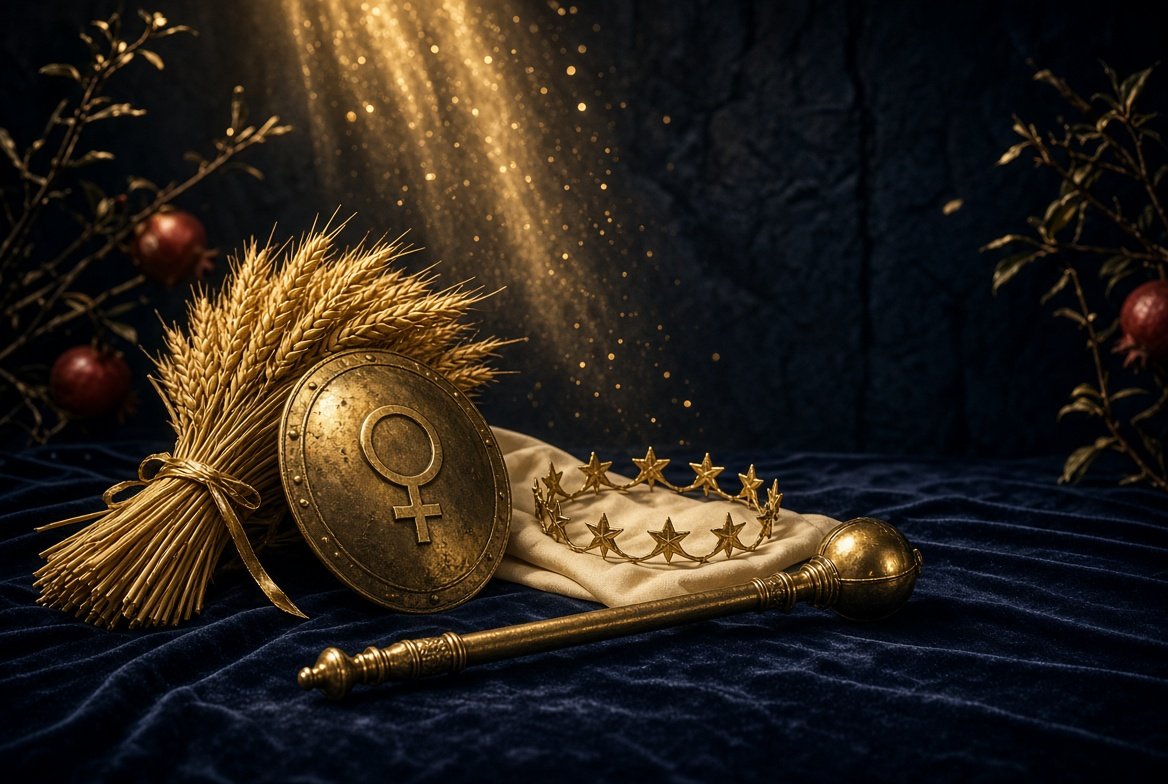
- Rider-Waite-Smith image (1909): a seated woman with a crown of twelve stars, a globe-topped scepter, a shield with the Venus symbol, ripening corn and a waterfall
- Earliest cards in our sources: the Visconti di Modrone card (about 1442) and the Visconti-Sforza card (about 1450)
- Astrological tradition: Venus, in the Golden Dawn system
What Does the Empress Mean in Tarot?
In the Rider-Waite tradition, the Empress stands for fruitfulness: things that grow, whether crops, projects or households. Waite called her a fruitful mother and tied her to universal fecundity. The tradition says she acts as well as nourishes, since action and initiative sit in his list next to fruitfulness. That part is easy. The harder part is the rest of his list, which the sections below cover.
The Mechanics: What the Card Shows
Pamela Colman Smith drew the 1909 image under Waite’s direction. The woman sits in a field of ripening corn, which in British usage of the period means grain. A waterfall runs behind her. She wears a crown of twelve stars, holds a scepter topped with a globe, and keeps a shield bearing the Venus symbol beside her. Waite describes her as a daughter of heaven and earth and calls the scene an earthly paradise, the lower counterpart of a higher one.
Watch for: Waite adds that she is a refuge for sinners. His text does not present her as purely gentle. The phrase sits oddly beside the sunny modern reading.
Macroscopic Symptoms: The Card’s Paper Trail
- About 1442: the Visconti di Modrone Empress, the earliest card in our sources, shows a crowned, enthroned woman with a shield bearing the imperial eagle. Tarot Heritage says that eagle was a Visconti emblem.
- About 1450: the Visconti-Sforza deck, one of the oldest surviving tarot decks, includes an Empress.
- 1600s: the Tarot de Marseille pattern settles. Her shield still carries the eagle and her scepter ends in an orb and a cross.
- 1909: Smith and Waite replace the eagle with the Venus symbol and set her in a meadow.
- 1880s and 1890s: the Golden Dawn assigns her Venus and the Hebrew letter Daleth.
The eagle is the quiet clue. The oldest cards present her as a court figure with imperial power. Waite’s deck turned her into a figure of nature. Both versions are tradition, and the second is the younger one.
Where Sources Disagree
- Who the early Empress was: Tarot Heritage suggests Bianca Visconti, wife of Francesco Sforza, may have modelled for both the Visconti-Sforza card and the Modrone card, and calls this a clue, not a fact. It also floats Barbara of Celje, wife of Sigismund, for the Modrone card. A site on the Visconti-Sforza deck says most scholars believe the painter used Bianca’s face. We could not trace that claim to a scholar, so we do not state the identification as settled.
- The Hebrew letter: see the next section. The traditions give two different letters.
- Waite’s reversed card: the printed list says light, truth and public rejoicings. A common modern page says the reversed card means exhaustion and an inability to create. The two disagree, and only one of them is Waite.
- Her symbols: Wikipedia credits Waite and other occultists with the star crown, the Venus emblem and the waterfall, and tags the claim as needing a citation. We state only what Waite’s own description says.
One Card, Three Letters
The tradition links each trump to a Hebrew letter. For the Empress, the systems disagree. Three traditions give two letters.
| System | Letter for the Empress |
|---|---|
| Éliphas Lévi (19th century) | Gimel |
| The French system, as Tarot Heritage describes it | Gimel |
| Golden Dawn (1880s and 1890s) | Daleth, with the planet Venus |
Papus, in his 1889 Tarot of the Bohemians, gives Daleth to the Emperor, the fourth card. That fits the French order, where the Empress holds the third letter, Gimel. The Golden Dawn moved Daleth to the Empress and tied it to Venus. Tarot writers argue over the reasons, and we report only the result. Llewellyn’s encyclopedia gives Gimel for Lévi and Daleth for the Golden Dawn, and Tarot Heritage says the French system gives Gimel. We have not read Lévi or the Golden Dawn papers directly.
The Five-Point Binary Grid: The Empress Upright and Reversed
This operational grid is our own diagnostic, not a traditional system. Waite’s words come from the 1910 text. The modern column is a common summary, for example the one on HowStuffWorks.
| Spec | Upright | Reversed |
|---|---|---|
| Waite’s words | Fruitfulness, action, initiative, length of days; the unknown, clandestine; difficulty, doubt, ignorance | Light, truth, the unravelling of involved matters, public rejoicings; vacillation |
| Common modern reading | Abundance, nurture, creativity | Exhaustion, an inability to create, rebuilding your own resources first |
| Direction | Output: something grows, with labour | Release: something tangled becomes clear |
| Systemic friction | Three of nine keywords are cautions, so the card is not pure good news | The modern reversed card contradicts Waite’s list |
| Containment | Choose one thing to start and set a review date | Check which source you are reading before you accept the verdict |
Recorded Symptoms
These are illustrative composites, not real case files.
Symptom 1. A reader draws the Empress before launching a side project and takes it as a green light for abundance. Waite’s list names difficulty, doubt and ignorance as well. She reads the first half and skips the second, then feels surprised by the doubt.
Symptom 2. A reader draws the Empress reversed and finds two pages. One says light and truth. The other says exhaustion. Both claim to describe the same card. He picks the one that matches his mood, which tells him about his mood and nothing about the card.
Insulation Protocols: Using the Empress on Your Terms
- Read Waite’s full list first. Compare any page you read with the nine upright keywords and the reversed list.
- Count the cautions. If a page quotes only the pleasant keywords, it has trimmed the source.
- Name the deck. The Rider-Waite-Smith card shows the Venus shield. Older Marseille-style cards show an eagle. Their pictures prompt different readings.
- Turn the card into one small action. Pick one thing to start and set a review date 30 days out.
- Keep health out of it. No card can tell you about pregnancy or fertility. Ask a clinician.
Plain note: no study shows that a tarot card predicts outcomes. If a reading worries you, stop and talk to a person.
FAQ
What does the Empress mean in tarot?
In Waite’s 1910 list, the upright Empress means fruitfulness, action, initiative and length of days, plus the unknown, difficulty, doubt and ignorance. Modern writers often shorten this to abundance, nurture and creativity. That is a later reading.
What does the Empress reversed mean?
Waite lists light, truth, the unravelling of involved matters and public rejoicings, with vacillation in another reading. Many modern pages say the reversed card means exhaustion or creative block. That is a later reading, and it contradicts Waite’s wording.
What does the Empress card show in the Rider-Waite deck?
She sits in a field of ripening corn with a waterfall behind her. She wears a crown of twelve stars, holds a scepter topped with a globe, and keeps a shield with the Venus symbol beside her.
Which Hebrew letter belongs to the Empress?
It depends on the tradition. The Golden Dawn gives her Daleth and Venus. Lévi and the French system give her Gimel.
Does the Empress mean pregnancy?
Waite’s list names fruitfulness and nothing about pregnancy. The pregnant mother image comes from later Golden Dawn tradition. No card predicts a pregnancy, and a clinician is the right person to ask.
Is the Empress my tarot year card?
No. Under the method on our year card calculator, birth month plus birth day plus 2027 reduces to a number from 5 to 17 only. The Empress is number 3, so no birth date lands on her.
Aftermath
The tradition says the Empress makes things grow. Waite’s own list says growth comes with difficulty, doubt and ignorance, and that her reversed card brings light and truth. Neither the modern summary nor Waite’s list is evidence about your future. For the card before her in the sequence, see our guide to The High Priestess, and for how the deck got its images, see the history of tarot.
External Data Check
Popular pages such as HowStuffWorks promise abundance, motherhood and creative growth, and that page calls the card a strong indicator of pregnancy. Waite’s list does not say that. It lists nine upright keywords, three of them cautions, and a reversed list that is mostly hopeful. The abundance is a modern emphasis laid over a 1910 text.
Sources
- Waite, A. E. (1910), The Pictorial Key to the Tarot: a scanned copy on the Internet Archive. Source for the card description and the upright and reversed keywords.
- Tarot Heritage, “L’Imperatrice / The Empress in Tarot”: the early decks, the eagle shield, the identity suggestions and the Golden Dawn and Waite changes.
- Wikipedia, The Empress (tarot card): the 1910 keyword list as a cross-check and the note on the card’s symbols.
- Llewellyn Encyclopedia, Empress: the Lévi and Golden Dawn letters.
We could not verify: Lévi and the Golden Dawn attributions at their original sources, the identity of the woman on the Visconti cards, the dating of the early decks beyond the sources cited, and the Papus detail, which we read in an English edition online. We did not survey the modern reading across many pages. We sampled a handful and cite one example. The keyword counts in this article are our own tally of Waite’s list.
Last reviewed: 9 November 2026.
Discover more from Divinity Digits
Subscribe to get the latest posts sent to your email.