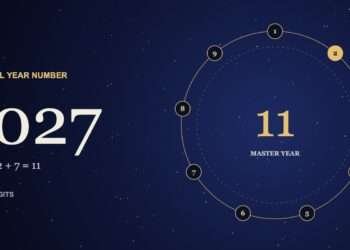

A Personal Year 8 opens January as a 9 and February as a 1. That is the whole mechanism of the personal month number: the year sets the theme, and the calendar month moves it one step at a time. The tradition says each month then carries its own smaller tone inside the year. Below you will find the method, a full 2027 table for every Personal Year, and the meaning the tradition gives each number. First, the limit: no study shows that a month number predicts anything.
The Mechanics: How to Calculate Your Personal Month Number
The calculation has two inputs. First, your Personal Year for 2027. Use our Personal Year 2027 calculator if you do not have it. Second, the calendar month as a number, with January as 1 and December as 12.
- Add your Personal Year to the month number.
- Reduce the total to a single digit by adding its digits until one digit remains.
- Master years: if your Personal Year is 11, 22 or 33, use its root (2, 4 or 6) in the sum.
Worked example one: a Personal Year 1 in June. 1 + 6 = 7. The month number is 7.
Worked example two: a Personal Year 22, root 4, in October. 4 + 10 = 14, then 1 + 4 = 5. The month number is 5.
Watch for: sources differ on whether personal months keep Master Numbers. This page reduces every month to a single digit, which keeps the table to nine rows.
The 2027 Table: Every Personal Year, Every Month
Find your Personal Year in the first column, then read across to the month. Each cell lists three months in order. Personal Years 11, 22 and 33 use the rows for 2, 4 and 6.
| Personal Year | Jan, Feb, Mar | Apr, May, Jun | Jul, Aug, Sep | Oct, Nov, Dec |
|---|---|---|---|---|
| 1 | 2, 3, 4 | 5, 6, 7 | 8, 9, 1 | 2, 3, 4 |
| 2 | 3, 4, 5 | 6, 7, 8 | 9, 1, 2 | 3, 4, 5 |
| 3 | 4, 5, 6 | 7, 8, 9 | 1, 2, 3 | 4, 5, 6 |
| 4 | 5, 6, 7 | 8, 9, 1 | 2, 3, 4 | 5, 6, 7 |
| 5 | 6, 7, 8 | 9, 1, 2 | 3, 4, 5 | 6, 7, 8 |
| 6 | 7, 8, 9 | 1, 2, 3 | 4, 5, 6 | 7, 8, 9 |
| 7 | 8, 9, 1 | 2, 3, 4 | 5, 6, 7 | 8, 9, 1 |
| 8 | 9, 1, 2 | 3, 4, 5 | 6, 7, 8 | 9, 1, 2 |
| 9 | 1, 2, 3 | 4, 5, 6 | 7, 8, 9 | 1, 2, 3 |
We generated the table by code and checked all 108 cells against every Personal Year and month.
What Each Month Number Means, According to the Tradition
| Number | The tradition says | Watch for: |
|---|---|---|
| 1 | Start. A month for decisions and first moves. | Starting more than you can finish. |
| 2 | Pair. A month for cooperation, patience and waiting. | Waiting on others as an excuse. |
| 3 | Express. A month for writing, speaking and social contact. | Scattered effort and idle talk. |
| 4 | Build. A month for structure, paperwork and routine. | Rigidity that blocks a needed change. |
| 5 | Change. A month for movement, travel and new options. | Impulse purchases and rushed commitments. |
| 6 | Home. A month for family, duty and responsibility. | Carrying other people’s load without asking. |
| 7 | Review. A month for study, rest and time alone. | Withdrawal that becomes avoidance. |
| 8 | Power. A month for money, contracts and authority. | Signing before reading. |
| 9 | Close. A month for finishing, clearing and letting go. | Clearing out things you still need. |
A Worked Year: Personal Year 5, Month by Month
A full example shows the mechanics better than a rule. Take someone born on 2 January. Their month reduces to 1, their day is 2, and the 2027 year adds 11, so 1 + 2 + 11 = 14, then 1 + 4 = 5. Their Personal Year for 2027 is 5. Now add each calendar month.
| Month | Sum | Month number | The tradition’s theme |
|---|---|---|---|
| January | 5 + 1 = 6 | 6 | Home |
| February | 5 + 2 = 7 | 7 | Review |
| March | 5 + 3 = 8 | 8 | Power |
| April | 5 + 4 = 9 | 9 | Close |
| May | 5 + 5 = 10, then 1 | 1 | Start |
| June | 5 + 6 = 11, then 2 | 2 | Pair |
| July | 5 + 7 = 12, then 3 | 3 | Express |
| August | 5 + 8 = 13, then 4 | 4 | Build |
| September | 5 + 9 = 14, then 5 | 5 | Change |
| October | 5 + 10 = 15, then 6 | 6 | Home |
| November | 5 + 11 = 16, then 7 | 7 | Review |
| December | 5 + 12 = 17, then 8 | 8 | Power |
Two patterns show up in this table and in every row of the full 2027 table. First, the numbers climb by one each month and wrap from 9 back to 1. Second, October repeats January, November repeats February and December repeats March. The reason is arithmetic: month 10 sits nine places after month 1, and adding nine never changes a digit-sum reduction. A reader who understands this can rebuild any row from memory, and can spot a typo in anyone else’s table.
The same logic explains why every Personal Year row contains all nine numbers. A twelve-month year runs through the nine-number cycle once and starts a second pass for three more months, so the first three months of the year recur in the last three.
Where Sources Disagree: Nine Cells Worth Knowing
In 9 of the 108 cells in the 2027 table, the raw sum comes to exactly 11 before reduction: a Personal Year 1 in October, a 2 in September, a 3 in August, a 4 in July, a 5 in June, a 6 in May, a 7 in April, an 8 in March and a 9 in February. Practitioners who keep Master Numbers in monthly cycles read those months as 11. Practitioners who reduce every month, as this page does, read them as 2.
We chose reduction for a practical reason: it keeps the method to nine meanings and nine rows, and it matches the approach of the guide we publish for download. It is a convention and not a discovery. If you follow a teacher who keeps the 11, use that teacher’s reading for those nine cells and ours for the rest.
Watch for: two websites that give different numbers for the same person and month. Check whether one of them keeps Master Numbers before assuming either has made an error.
Three Errors That Produce the Wrong Number
- Using your birth month. The calculation uses the calendar month you are in, from 1 for January to 12 for December, not the month you were born.
- Using last year’s Personal Year. The Personal Year changes on 1 January. A 2026 number applied to a 2027 month gives a different, wrong answer. Our Personal Year calculator shows both so you can see the shift.
- Confusing the Personal Year with the Universal Year. The Personal Year depends on your birthday and the calendar year. The Universal Year, 2027 reduced, is the same for everyone.
The Personal Day, and Why We Stop Here
The tradition extends the method one layer further. A Personal Day adds the Personal Month to the calendar day and reduces. A Personal Year 1 person in June has a month number of 7, so 14 June gives 7 + 14 = 21, then 2 + 1 = 3. Teachers of the system use daily numbers to plan small tasks.
We do not build on this layer. A month gives the method a thirty-day sample, and a day gives it a single observation that nobody can test. Every added layer multiplies the chances that something will seem to fit by luck. If you want to test the method honestly, test the month.
A Twelve-Month Log You Can Copy
The most useful thing a reader can do with this page is keep a log. Copy the table below into a notebook or a spreadsheet, fill in your month numbers from the 2027 table, and write one concrete priority for each month before it starts. At the end of each quarter, mark whether the theme fit what happened.
| Month | Your number | One priority (written in advance) | Did the theme fit? Yes, partly or no |
|---|---|---|---|
| January | |||
| February | |||
| March | |||
| April | |||
| May | |||
| June | |||
| July | |||
| August | |||
| September | |||
| October | |||
| November | |||
| December |
The order matters. Write the priority before the month begins, and mark the fit at the end of the quarter, not at the end of each month. Memory edits quickly, and a theme that seemed wrong in week one often seems right by week four. If the log shows the themes fit no better than guessing would, you have learned something honest about the method, and that is a result worth having.
Macroscopic Symptoms: Where the Method Comes From
- Nine-year loops: modern Western numerology treats life as repeating cycles of nine, each year carrying one theme.
- 1908: bibliographers credit the rule of never reducing 11, 22 or 33, now called the Master Number rule, to Mrs. L. Dow Balliett, author of The Philosophy of Numbers.
- Modern cycles: the personal year and personal month cycles used here follow the approach of Hans Decoz at worldnumerology.com.
- Where it stops: the monthly layer is modern practice. We did not trace it to a primary source, so treat the rule as a convention, not a tradition with a documented origin.
The Five-Point Binary Grid: Personal Year vs Personal Month
This operational grid is our own diagnostic, not a traditional system.
| Spec | Personal Year | Personal Month |
|---|---|---|
| Scope | Twelve months, one theme | One calendar month |
| Input | Birth month, birth day and 2027 | Personal Year plus the month number |
| Kinetic energy | Slow: sets the direction | Fast: changes every thirty days or so |
| Systemic friction | Comes from ignoring the year’s theme | Comes from over-reading a single month |
| Containment | Choose one goal for the year | Choose one priority for the month |
Recorded Symptoms
These are illustrative composites, not real case files.
Symptom 1. A shop owner in a Personal Year 4 reaches October, a 5, the change month. She rearranges the store during the pre-holiday rush. The number said change. The calendar said busiest weeks of the year.
Symptom 2. A student in a Personal Year 9 sees March as a 3, the expression month, and writes three essays. He would have written them anyway, because the deadlines were in March.
Insulation Protocols: Using the Month Number on Your Terms
- Write your Personal Year first. Do not read a month number without it.
- Name one priority per month, in your own words, before you read the tradition’s theme.
- Test the theme every quarter. Ask whether it fit what actually happened. If it did not, drop it.
- Never schedule an irreversible decision by number. Sign, quit or move on facts, not on a 5 or an 8.
- Keep a log. A diagnostic that is never tested is just a horoscope.
Plain note: no study shows that birth dates or numbers predict outcomes. People tend to notice what they expect to notice, an effect called confirmation bias. Judge the method by whether it helps you plan.
FAQ
What is a personal month number?
It is a single digit, 1 to 9, formed by adding your Personal Year number to the calendar month number. The tradition says it describes the tone of that month inside your year.
How do you calculate your personal month number?
Add your Personal Year to the month number (January is 1, December is 12) and reduce to a single digit. A Personal Year 3 in May is 3 + 5 = 8.
Do Master Numbers apply to personal months?
Sources differ. This page reduces every personal month to a single digit and uses the root of a Master Personal Year (11 uses 2, 22 uses 4, 33 uses 6).
When does my personal month change?
We use the calendar month, so it changes on the first. Some practitioners tie cycles to the birthday instead. Sources differ, and nobody has tested either.
Can two people have different month numbers in the same month?
Yes. Anyone with a different Personal Year gets a different number. In 2027 there are nine distinct month rows, so people in Personal Years 2 and 11 share one.
Aftermath
The tradition says the year gives the theme and the month gives the timing. The table above is arithmetic, and the meanings are interpretation. Neither is evidence. Use the number as a prompt to choose one priority, then judge it by what happens. For the year-level reading, see the Personal Year 2027 guide, or compare with last year’s Personal Year 2026 reading.
External Data Check
Pages about the personal month number tend to describe each month with confident predictions: money in an 8 month, love in a 6 month. No controlled test supports that. Vague, flattering descriptions feel accurate to almost everyone, which is the Barnum effect. For a neutral summary of the field and its critics, see the Wikipedia entry on numerology.
Sources
- Our own arithmetic: all 108 cells of the 2027 table, the Personal Year 5 worked example and the nine “11” cells, recomputed in code.
- The Personal Year method used on this site: our Personal Year 2027 calculator.
- The personal year and personal month approach follows Hans Decoz at worldnumerology.com. Bibliographers credit the Master Number rule to Mrs. L. Dow Balliett, The Philosophy of Numbers (1908).
We could not verify at a primary source: who first set the monthly rule, and the 1908 attribution, which we know from secondary bibliographies and not from the book itself. The meanings in the table are tradition and not findings.
Last reviewed: 3 November 2026.
Discover more from Divinity Digits
Subscribe to get the latest posts sent to your email.