The card most often sold as “new beginnings” was first described by its own designer as folly, mania and extravagance. A. E. Waite, who directed the 1909 Rider-Waite deck, listed those words for the Fool upright. Today most tarot sites read the same card as a fresh start and a leap of faith. Both readings are in circulation, and the gap between them is the fastest way to see how tarot meanings get built.
The Mechanics: What the Card Shows
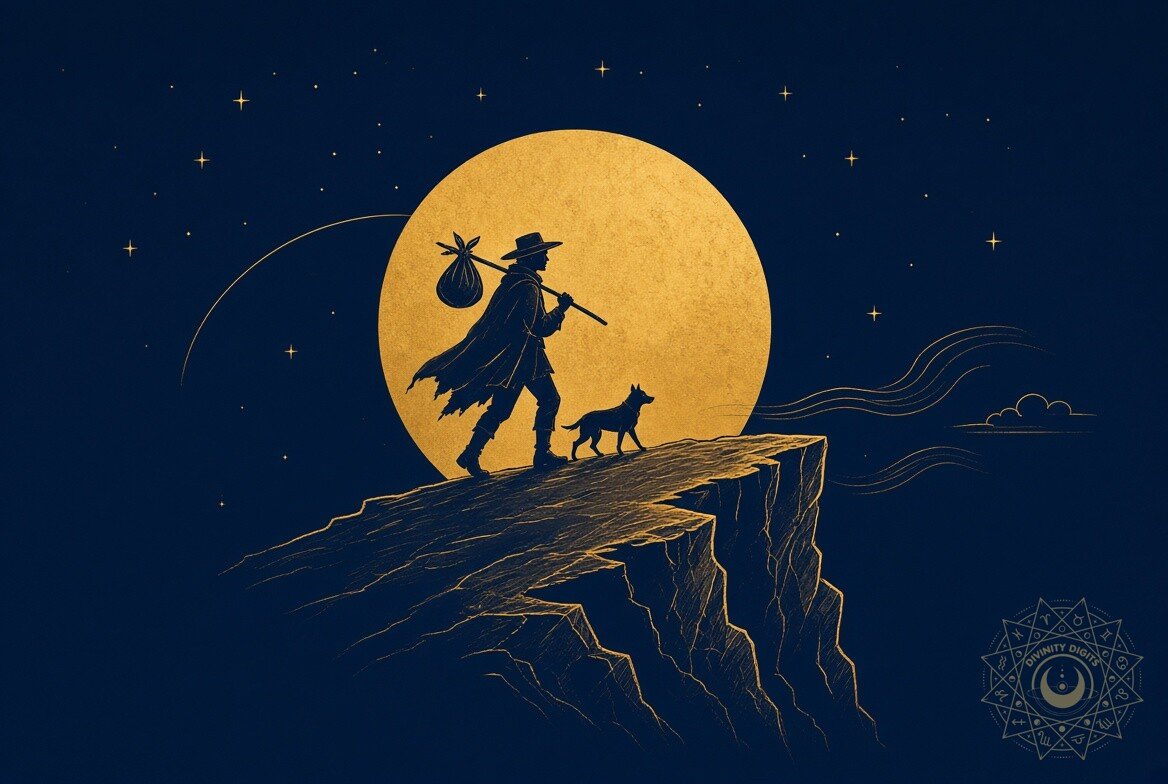
In the 1909 Rider-Waite deck, published in December of that year by William Rider & Son, Pamela Colman Smith illustrated the card to Waite’s instructions. A young man walks toward a precipice. A small dog is at his heels, he holds a white rose, and he carries a small bundle of possessions. He is looking up, not down, which is the whole diagnostic: the card shows a person about to step without checking the ground.
The name carries the same warning. In Marseille decks the card is Le Mat, and in most Italian decks it is Il Matto. Both mean “the madman.”
Macroscopic Symptoms: The Card’s Paper Trail
- Mid-15th century. Early painted decks such as the Visconti-Sforza and the Pierpont Morgan Bergamo already include a Fool among the trumps.
- 15th century, Sola Busca. This deck labels the card 0, one of the earliest numberings on record.
- 1639. The earliest surviving Marseille-pattern cards, made by Philippe Vachier of Marseille, treat the Fool as separate from the 21 numbered trumps. It usually carries no number.
- 1723 to 1751. Numbering was not settled. A 1723 deck by Adam C. de Houtot numbers the Fool XXII, while Swiss decks by Rochus Schar (1750) and Burdel (1751) number it zero.
- 1909. The Rider-Waite deck prints the number 0. Waite still discusses the card between trumps 20 and 21 in his companion book.
- 1970. Eden Gray gave the Fool’s walk through the 21 numbered trumps a name in the epilogue of A Complete Guide to the Tarot. She had hinted at the idea in Tarot Revealed (1960).
The pattern is the diagnostic: the card that sits outside the numbered sequence is the one most often rewritten.
The Five-Point Binary Grid: Upright and Reversed
Waite’s keywords for the upright Fool are folly, mania, extravagance, intoxication, delirium and frenzy. For the reversed card he lists negligence, carelessness, apathy and vanity. Modern readers soften both. Run the card through this operational grid.
| Check | Upright | Reversed |
|---|---|---|
| Waite’s keywords | Folly, mania, extravagance | Negligence, carelessness, apathy |
| Modern reading | New beginning, trust, spontaneity | Recklessness, or fear of starting |
| Strength | Willingness to start without a guarantee | Caution that stops a bad leap |
| Risk | Ignoring the cliff edge | Never taking the first step |
| Question to ask | What am I starting without checking? | What am I avoiding starting? |
Recorded Symptoms
These two vignettes are illustrative composites, not real cases.
Recorded Symptom 1. A querent draws the upright Fool the night before handing in notice at a salaried job and reads it as permission. The card never says whether the edge is a step or a drop. It cannot weigh rent, savings or a second offer, so the permission was extraction: the reader pulled it out of an image that held none.
Recorded Symptom 2. Another querent draws the reversed Fool before applying for a course and reads it as a warning to wait. A different reader would take the same card as a push to stop hesitating. One card supports two opposite decisions, which is the systemic friction in every single-card reading.
Insulation Protocols: Using the Fool Without Being Used by It
- Read both layers. Note Waite’s wording and the modern one, then decide which fits the question you actually asked.
- Take the question, not the verdict. The grid above ends in a question for a reason. The answer has to come from you.
- Price the fall. Write down what you lose if the step fails, in money, time and people.
- Set a limit. Decide in advance how much you can lose and stick to it.
- Containment. Make no money, health or relationship decision from the card alone.
The Fool is kinetic energy with no brakes printed on the card, and the protocols above supply the brakes. Divinity Digits describes what the tradition says about each card. No study shows that a drawn card predicts personality or events.
FAQ
Is the Fool a good or bad card?
Neither. Waite’s keywords are negative, modern readings are mostly positive, and the image itself shows a person at risk and in motion. Read it as a card about starting without certainty.
Why is the Fool numbered 0?
Old decks mostly left it unnumbered because it sits outside the 21 numbered trumps. Some decks number it 0 or XXII, and the Rider-Waite deck settled on 0 in 1909.
Is the Fool the same as the Joker?
Possibly related, but not proven. The Fool may be the Joker’s precursor, though the Joker more likely developed on its own in the 1850s as a permanent trump in the card game Euchre.
What is the Fool’s walk through the trumps?
It is a modern storytelling frame in which the Fool meets each of the 21 numbered trumps in order. Eden Gray named it in 1970. It is a teaching device, not an old tradition.
Does drawing the Fool mean something new is coming?
No. A card has no knowledge of your life. It gives you a prompt, and the meaning comes from how you read it.
Aftermath
The Fool is the clearest case of tarot meaning being built by people over centuries, from a 15th-century trump with no number to a modern symbol of fresh starts. For the wider background, read our History of Tarot.
External Data Check
Some card-meaning sites present the Fool as an ancient, fixed symbol. The earliest tarot cards on record are 15th-century Italian decks, and the number on this card has changed from one deck to the next.
Discover more from Divinity Digits
Subscribe to get the latest posts sent to your email.