The history of tarot starts with a card game, not a fortune teller. The earliest tarot cards were made in northern Italy in the 1400s for a trick-taking game, and the first known manuscript explaining how to read them for divination appears around 1750, more than 300 years later. Along the way, a French writer invented an Egyptian origin that never existed, and a 1909 London deck changed what tarot looks like to this day. This guide follows the paper trail and says clearly where the evidence stops.
As with everything on this site, tarot reading is a tradition, not a tested method. No study shows that a card draw predicts events. What follows is the history of the cards themselves, which is well documented.
Tarot Began as a Card Game in 15th-Century Italy
Tarot cards first appeared in northern Italy, in the cities of Milan and Ferrara, as ordinary Italian playing cards with extra cards added. A standard pack had four suits, and someone added 21 special trump cards and a Fool. The earliest written record is a Florentine court document from 1440 about transferring two decks. The oldest cards that survive are the Visconti-Sforza decks, painted in the mid-1400s for the rulers of the Duchy of Milan.
The cards were not called tarot at first. They were called trionfi, meaning triumphs, because the trump cards beat the others in play. The name tarocchi came later, and the form “Tarocho” first appears in Brescia around 1502. Our word “tarot” comes from it.
Tarot games were played for centuries, and they still are. The best known today is French Tarot, which is played with a standard 78-card deck. The earliest known complete rules were published in France in 1637.
How Many Cards Are in a Tarot Deck?
A standard tarot deck has 78 cards, split into two groups:
- Major Arcana: 22 cards without a suit, made up of the Fool and 21 trumps, such as The Magician, The Lovers and The World.
- Minor Arcana: 56 cards in four suits of 14, with ten numbered cards and four court cards in each suit.
The words “Major Arcana” and “Minor Arcana” are not from the 1400s. They were introduced much later by the French occult writer Jean-Baptiste Pitois, who wrote as Paul Christian. Tarot card players never use them. You can see all 22 Major Arcana cards on our tarot page.
When Did Tarot Become Fortune Telling?
Not until the 1700s. The earliest known evidence of tarot used for cartomancy, which means divination with cards, is an anonymous manuscript from about 1750. It gives divinatory meanings for the cards of the Tarocco Bolognese, a deck from Bologna. Historians who have searched for older evidence report no significant sign of fortune telling with tarot before the late 1700s.
That gap matters. The popular story that tarot was designed as a mystical tool is a modern claim. For its first three centuries, tarot was something you played, not something you consulted.
The Egyptian Origin That Never Happened
In 1781, the French scholar Antoine Court de Gébelin published an essay claiming that tarot was a book of ancient Egyptian wisdom, hidden in plain sight as a card game. The claim was false. There is no evidence that tarot existed in ancient Egypt, and the earliest cards are Italian. It spread anyway, because it sounded ancient and exotic.
In the same decade, a Parisian named Jean-Baptiste Alliette, who called himself Etteilla, made tarot a business. He worked with the Tarot of Marseilles and, around 1789, produced the first deck designed specifically for occult use. Between them, these two men created the modern idea of tarot as a mystical system. They did it about 350 years after the first cards were painted.
The 1909 Deck That Changed Tarot
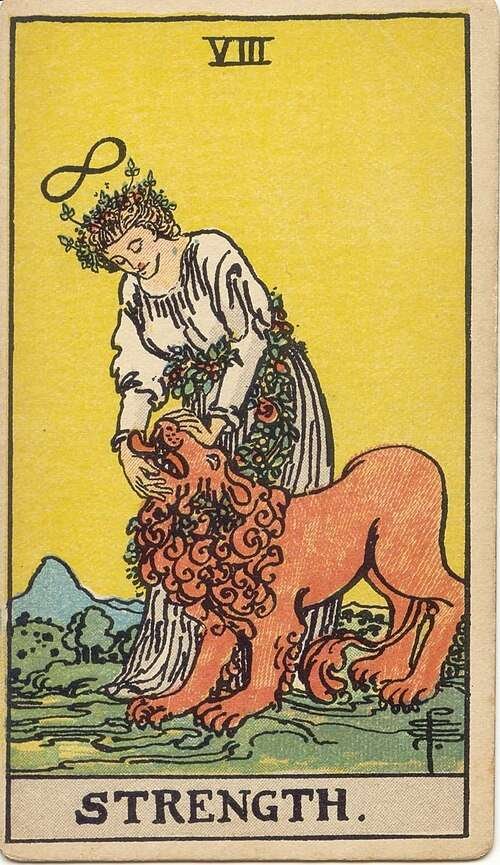
Most tarot decks sold today copy a deck first published in December 1909 by William Rider & Son of London. It is known as the Rider-Waite-Smith deck, after the three people most tied to it:
- William Rider & Son: the publisher.
- Arthur Edward Waite: the mystic and scholar who directed the design.
- Pamela Colman Smith: the artist who painted the images.
Its big innovation was in the Minor Arcana. Earlier decks mostly showed simple repeated suit symbols on the numbered cards, so the Five of Cups looked like five cups. Smith drew each of the 56 cards as a small scene with people in it, which made every card easier to read and remember. Both Waite and Smith belonged to the Hermetic Order of the Golden Dawn, a late-1800s occult society, and its teachings shaped the symbolism. To match the Golden Dawn’s astrological system, Waite swapped the positions of Strength and Justice, which is why they are numbered 8 and 11 in this deck and in the opposite order in older ones.
Is Tarot Ancient? What the Evidence Says
- Documented: tarot cards existed in Italy by 1440, as a card game.
- Documented: tarot divination appears in writing around 1750.
- Not supported: any link to ancient Egypt, or to a secret tradition older than the 1400s.
- Not supported: any evidence that a reading predicts events.
Tarot’s real age is about 580 years, which is old enough to be interesting without any invented history.
Frequently Asked Questions
Where did tarot cards come from?
Northern Italy, in the mid-1400s. They were made in Milan and Ferrara as playing cards with extra trump cards, for a game, not for divination.
Did ancient Egypt invent tarot?
No. That idea comes from a 1781 essay by Antoine Court de Gébelin, and there is no evidence for it.
Who made the Rider-Waite-Smith deck?
It was published by William Rider & Son in December 1909. Arthur Edward Waite directed the design and Pamela Colman Smith painted the images.
Can tarot cards predict the future?
No study has shown that they can. Many people use readings as a prompt for reflection, which is a different thing from prediction.
How many cards are in a tarot deck?
78: 22 Major Arcana and 56 Minor Arcana.
The Honest Answer
Tarot began as a card game, became a fortune-telling tool in the 1700s, and gained its mystical reputation from stories that were invented, then repeated. The cards are real and the history is rich. The evidence that they foretell anything is missing. If you enjoy a reading, treat it as a way to think about your own situation, and not as a forecast.
Sources: Tarot (Wikipedia) and Rider-Waite Tarot (Wikipedia).
Discover more from Divinity Digits
Subscribe to get the latest posts sent to your email.